


There is something about a decorated cookie that feels more personal than any other Valentine’s Day treat. You can buy chocolates anywhere, but a heart-shaped sugar cookie with a little message piped on top — soft, buttery, finished in pastel icing — that is something someone made specifically for you. These Valentine’s Day heart sugar cookies are inspired by the iconic conversation heart candies that have been an American Valentine’s Day staple for over a century, and they taste considerably better than the originals.
The dough comes together with just 7 to 8 simple ingredients, the cookies hold their shape perfectly in the oven, and the royal icing decorating is as simple or as elaborate as you want to make it. Whether you are baking with kids, putting together Valentine’s gift boxes, or just want something beautiful on the table on February 14th — this is the recipe.
Quick Answer
Make a simple butter-based sugar cookie dough, roll it out, chill for at least 2 hours, cut into heart shapes, bake for 12 minutes, then decorate with pastel royal icing and piped messages to create conversation heart-inspired Valentine’s Day cookies. Soft centres, crisp edges, flat tops perfect for decorating.
Table of Contents
What Are Conversation Heart Cookies — and Why They Work for Valentine’s Day
If you grew up in or around American culture, you know conversation heart candies. They are small, pastel-coloured, slightly chalky sweets embossed with short messages — “Be Mine,” “XOXO,” “True Love,” “Cutie” — and they have been a Valentine’s Day fixture for well over a hundred years. The company that makes them releases a new theme and new sayings every single year, which is part of what keeps them culturally relevant decade after decade.
These cookies are the homemade, infinitely more delicious version of that idea. Same pastel colours, same little messages, same heart shape — but instead of chalky candy, you get a soft, thick, buttery sugar cookie with slightly crisp edges and a flat top that is practically designed for decorating. The royal icing sets firm enough to stack and package without smudging, which makes these ideal for gifting as well as eating.
For the Indian diaspora community, conversation hearts are a fun, culturally curious thing — recognisably American, charming in their simplicity, and easy to personalise with messages that feel closer to home. Imagine piping “Chai Pe?” or “Dil Se” on a pastel pink heart cookie. That is the kind of Valentine’s Day baking that lives at the intersection of two cultures and feels genuinely your own.
CHECK MORE ON:Sabudana Vada Recipe: Perfect Crispy Fasting Snack

Why This Sugar Cookie Recipe Works So Well for Decorating
Not all sugar cookies are created equal. Some spread in the oven and lose their shape. Some puff up unevenly and give you a bumpy surface that is impossible to pipe on cleanly. This recipe solves both problems by design. The dough is rolled out before chilling — not after — which is the key technique that makes the difference between cookies that hold a sharp, precise heart shape and ones that turn into soft blobs by the time they hit the baking tray.
The cookies themselves are soft and thick in the centre with slightly crisp edges — exactly the texture balance that makes a decorated sugar cookie genuinely enjoyable to eat, not just to look at. The flavour is buttery vanilla with an optional touch of almond extract that adds a subtle warmth without being identifiable. Many bakers who have made these describe the almond addition as the thing that makes the cookies taste like they came from a bakery rather than a home kitchen.
The recipe has been tested by beginner and experienced bakers alike, with consistent results. One baker reported making it approximately 50 times. That kind of track record tells you everything you need to know about reliability.
Ingredients for Valentine’s Day Heart Sugar Cookies
The cookie dough uses 7 to 8 straightforward ingredients, most of which are already in your pantry:
For the Sugar Cookie Dough:
| Ingredient | Role in the Recipe |
|---|---|
| Butter (unsalted, softened) | Base of the dough — provides richness and that irresistible buttery flavour |
| Granulated sugar | Sweetness and structure when creamed with butter |
| Egg | Binds the dough and provides structure |
| Vanilla extract | Classic warm flavour base |
| Almond extract (optional but recommended) | Subtle depth that elevates the overall flavour significantly |
| All-purpose flour | Structure and body |
| Baking powder | A little lift for soft, thick centres |
| Salt | Balances the sweetness and sharpens every other flavour |
For the Royal Icing:
| Ingredient | Role in the Recipe |
|---|---|
| Meringue powder | Replaces raw egg whites — gives the same consistency without the food safety concern |
| Powdered sugar | Base of the icing |
| Water | Adjusts consistency for flooding versus writing |
| Gel food colouring | Vivid pastel colours — gel over liquid for richness without affecting icing consistency |
The meringue powder is worth tracking down specifically for this recipe. It replaces the raw egg whites used in traditional royal icing, which is particularly relevant for households with young children, pregnant guests, or anyone who prefers to avoid raw eggs. It is available in the baking aisle of most supermarkets, at craft stores with baking sections, or online.
Equipment You Will Need
Beyond the standard mixing bowls and baking sheets, a few specific tools make this recipe significantly easier and the results considerably more polished.
A rolling pin is essential — and if you find it difficult to roll dough to an even thickness consistently, an adjustable rolling pin is genuinely worth the investment. Uneven thickness means some cookies bake faster than others, and you end up with a mix of overdone edges and underdone centres.
Heart-shaped cookie cutters are the star of the show. The 3.5-inch size works particularly well for these conversation heart-style cookies because it gives you enough surface area to pipe words on top. Anything smaller and the writing becomes frustratingly cramped. The Ann Clark brand is a consistent favourite among home bakers for clean, sharp edges that transfer cleanly to the baked cookie.
Piping bags and tips are what separate a cleanly decorated cookie from a messy one. For the royal icing base — both outlining and flooding — a Round Tip #4 is ideal. For the writing on top, a Round Tip #2 gives much finer control. If you only have one piping tip, a coupler lets you transfer it between bags of different coloured icing without needing multiple tips.
Silicone baking mats or parchment paper are not optional — they are what allow you to roll out the dough and transfer the entire sheet directly to the refrigerator for chilling, which is the technique that makes shape-holding possible.
How to Make Valentine’s Day Heart Sugar Cookies — Step by Step
The order of steps here matters more than in most recipes. Follow the sequence carefully and the results will be consistently excellent.
Step 1: Make the Cookie Dough
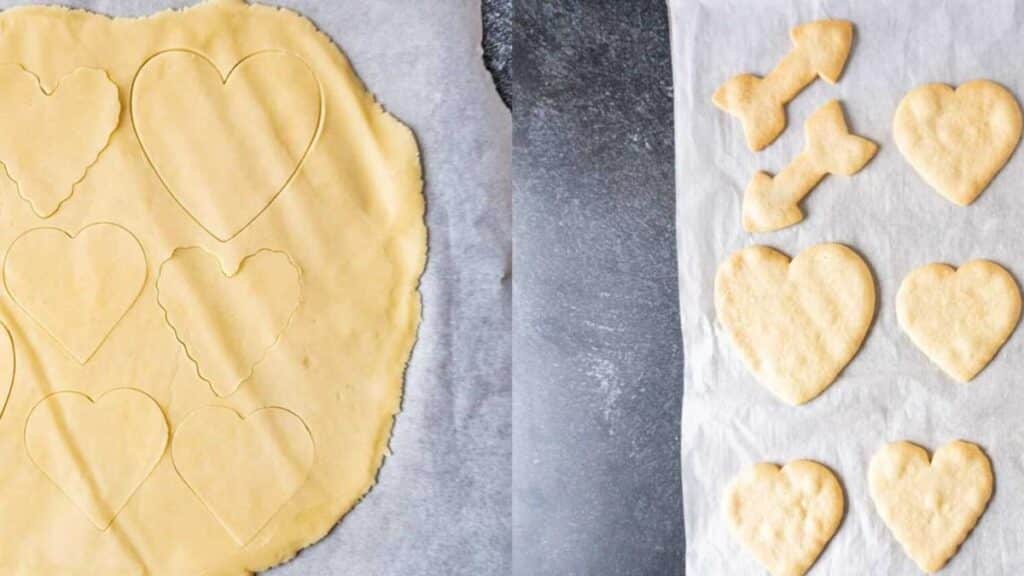
Cream the softened butter and sugar together until light and fluffy — this usually takes about 2 to 3 minutes with an electric mixer. Add the egg, vanilla extract, and almond extract (if using) and beat until incorporated. Sift together the flour, baking powder, and salt, then add to the wet ingredients and mix until a soft dough forms.
Step 2: Divide and Roll Immediately
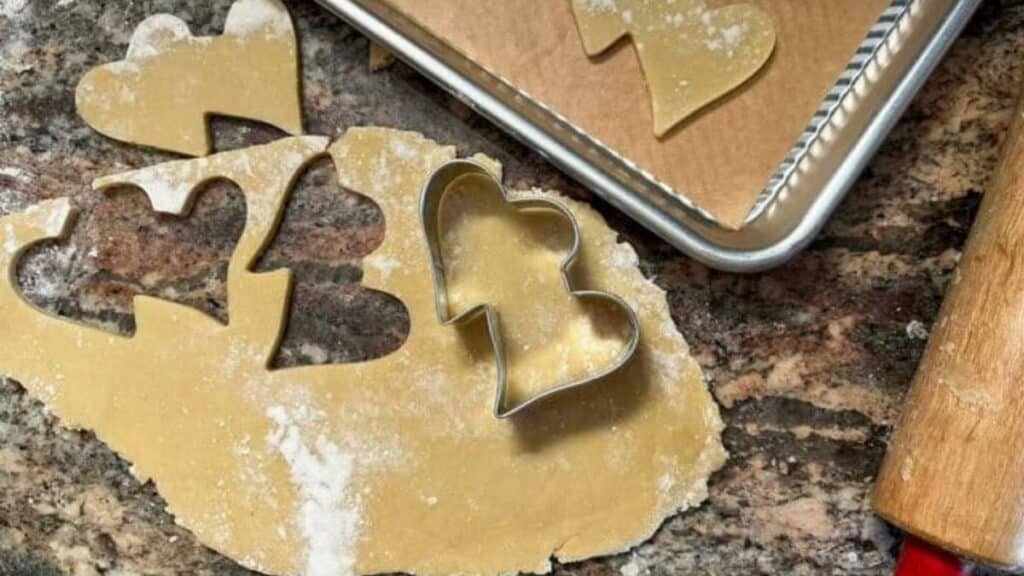
Divide the dough into two equal pieces. Working with one piece at a time, roll it out directly onto a piece of parchment paper or a silicone baking mat to a consistent ¼-inch thickness. This is the crucial step — roll the dough now, while it is soft and pliable, not after chilling.
Step 3: Chill the Rolled Dough

Slide the parchment or silicone mat with the rolled dough onto a baking sheet and transfer to the refrigerator. Chill for at least 2 hours, and up to 2 days if you are preparing in advance. If your refrigerator space is limited, stack the two rolled sheets on top of each other with parchment between them.
Step 4: Cut Into Hearts

Remove the chilled dough from the refrigerator and cut immediately using your heart-shaped cookie cutter. Press firmly and cleanly — a single clean press gives sharper edges than a rocking or twisting motion. Transfer the cut shapes to a lined baking sheet, spacing them about an inch apart.
Step 5: Bake

Bake at the temperature specified in your recipe for approximately 12 minutes, depending on the size of your cookies. The cookies are done when the edges are just barely golden and the centres look set but not browned. They will feel slightly soft when they come out — that is correct. They firm up as they cool.
Step 6: Make the Royal Icing

Beat the meringue powder, powdered sugar, and water together until the icing is smooth, glossy, and holds stiff peaks. This is the base consistency. Divide into separate bowls and tint each with gel food colouring — soft drops of yellow, pink, violet, green, and orange create the pastel conversation heart palette.
Step 7: Decorate — Outline, Flood, Then Write

Pipe an outline around the edge of each heart cookie using the #4 tip and flooding-consistency icing. Then fill in the centre by flooding — piping icing within the outline and using a toothpick to spread it to the edges. Let the base coat dry completely before adding the writing, ideally for 2 hours or overnight. A wet base coat will cause the writing to sink and blur.
What to Write on Valentine’s Day Conversation Heart Cookies
The messages are half the charm. Classic options include XOXO, Be Mine, True Love, Cutie, Kiss Me, and You’re Mine. But for an Indian diaspora twist, consider: Dil Se, Chai Pe, Mera Dil, Always, Shukriya, or simply a red heart piped in the centre. You do not need calligraphy-level skills — slightly imperfect handwriting piped in icing has its own charm, and nobody receiving a homemade cookie is grading the penmanship.
If piping writing feels intimidating, start with simple symbols rather than words. A small heart, a star, or three dots in a diagonal line are all much easier than letters and still look deliberate and beautiful. Build confidence with symbols first and graduate to words once the icing feels familiar in your hand.
Tips for Perfect Royal Icing Every Time
Royal icing is the most technically involved part of this recipe, but it becomes intuitive quickly once you understand the consistency distinctions. The flooding consistency should be thin enough to spread to the edges of the cookie on its own within about 10 seconds of piping — if it holds its shape and does not spread, it is too thick. If it runs immediately off the edge of the cookie, it is too thin. Add water or powdered sugar by the half-teaspoon until you find the balance.
Always let the flood coat dry completely before adding writing or details on top. Two hours is the minimum, but overnight is better if you are making these ahead. Icing that looks dry on the surface can still be soft underneath, and writing piped on soft icing sinks and blurs. Patience at this stage is what separates beautiful cookies from disappointing ones.
Gel food colouring is genuinely superior to liquid for royal icing. Liquid colouring adds water to the icing, which changes the consistency and can require significant adjustment. Gel gives rich, vivid colour with just a tiny amount — a single small drop is enough for deep tones, and a fraction of a drop on a toothpick is sufficient for the pastel shades used in conversation heart cookies.
How to Store and Package Valentine’s Day Sugar Cookies
Once the icing is fully set — allow at least 4 to 6 hours, ideally overnight — the cookies stack beautifully without smudging, which makes them ideal for gifting. Stack them in cellophane bags tied with red or pink ribbon, layer them in a tin with parchment between each layer, or arrange them in a box as a Valentine’s Day cookie assortment.
Undecorated cookies freeze beautifully for up to 3 months. Thaw at room temperature still wrapped, and decorate after thawing. Decorated cookies are best eaten within 1 week stored in an airtight container at room temperature. Refrigerating decorated cookies can cause the icing to become sticky as condensation forms — room temperature storage is better for maintaining that clean, set finish.
Why do my sugar cookies spread in the oven and lose their shape?
The most common cause is skipping or shortening the chilling step.
Can I make the dough ahead of time?
Yes. Roll it out, place on parchment, and refrigerate for up to 2 days before cutting and baking
