


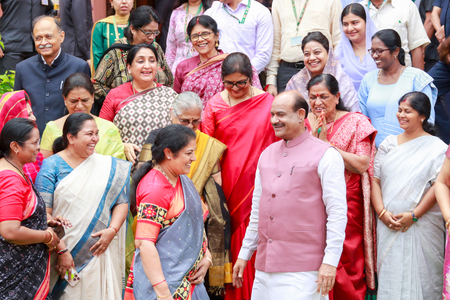
The Centre is gearing up to introduce two crucial bills in Parliament to enable one-third reservation for women in legislative bodies. Female MPs from various parties have welcomed this move, emphasizing its importance for empowerment and inclusive development in the country. The government aims to separate the implementation of women’s reservation from the pending delimitation exercise to garner broader political support for amending the Nari Shakti Vandan Adhiniyam.
Union Home Minister Amit Shah recently engaged in discussions with leaders of several non-Congress opposition parties as part of this outreach effort. The proposed legislative changes involve amendments to the Women’s Reservation Act, 2023, which previously tied the quota’s implementation to the completion of the next Census and subsequent constituency delimitation. Due to delays in the Census process, the government is contemplating using the 2011 Census data as a basis for moving forward.
MPs like Kamaljeet Sehrawat from the BJP have expressed approval for the initiative, citing the Prime Minister’s clear stance on women’s empowerment and the meticulous preparation preceding decisions on this matter. Shiv Sena(UBT) Rajya Sabha MP Priyanka Chaturvedi also voiced support, highlighting the long-overdue right of women to representation, respect, and equality through this amendment based on the 2011 census data.
Lovely Anand, a JD(U) MP, described the development as a positive step towards empowering women and emphasized the importance of women’s active participation in the country’s progress. Congress Rajya Sabha member Rajani Patil echoed this sentiment, acknowledging the historical significance of the women’s reservation and its association with former Prime Minister Rajiv Gandhi. Samajwadi Party MP Iqra Hassan stressed the importance of implementing the Bill on the ground rather than just on paper, expressing satisfaction with the government’s renewed focus on this issue.
The proposed move is anticipated to reshape India’s political landscape significantly and align with Prime Minister Narendra Modi’s emphasis on women-led development. If executed as planned, the Lok Sabha’s seat count could rise by nearly 50%, reaching 816 seats, with an additional 273 seats reserved for women. This expansion aims to ensure a smooth transition to a more inclusive parliamentary structure without displacing current male members, while also increasing the majority mark to 409 seats in the Lok Sabha.
