


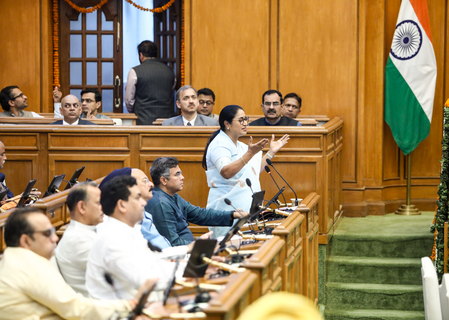
Delhi Chief Minister Rekha Gupta revealed plans to create the Delhi Institutional Think Tank (DITI) akin to NITI Aayog, alongside introducing semiconductor and drone policies to position the city as a technology and manufacturing hub. In the Budget 2026-27 presentation, she announced the establishment of 13 mini secretariats to enhance governance and provide integrated public services.
All properties will be allocated a unique ID (‘Bhu-Aadhaar’) and land records digitized through the NGDRS portal. District magistrates will receive Rs 59 crore from the district development fund, with the introduction of a modern, paperless, and faceless registration system. Additionally, a state-of-the-art Emergency Operations Centre will be established at a cost of Rs 10 crore.
The Chief Minister outlined plans to bolster the city’s judicial infrastructure by constructing new court complexes in various locations and a family court in Rohini. Other initiatives include building a forensic science lab in Sheikh Sarai, a high-security jail in Narela, and separating Delhi’s public account from the Union government’s account. Moreover, allocations have been made to support MSME common facility centers, a new warehousing policy, and training for MSMEs under the RAMP scheme.
The budget also earmarks funds for tourism, art, culture, and language development, including initiatives like the ‘Branding Delhi’ campaign and hosting the city’s first International Film Festival. Noteworthy proposals encompass the construction of modern toilets, beautification of major junctions, and the development of a ‘Delhi Sadan’ and the Institute of Hotel Management. Furthermore, plans for a new film policy, AVGC policy, and the transformation of Town Hall into a global heritage center are in the pipeline.
