


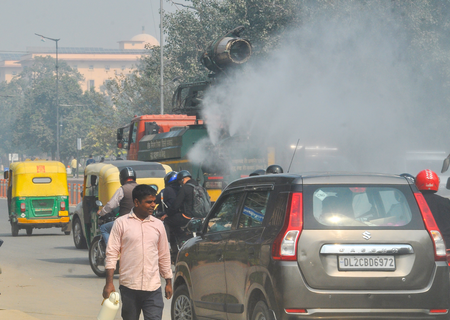
The air quality in Delhi stayed in the ‘poor’ category, with Anand Vihar showing ‘very poor’ conditions at an AQI of 342. Various monitoring stations in the city reported different air quality levels, with most areas falling under the “poor” category. Delhi-NCR is experiencing a rise in temperatures, although mornings and evenings remain relatively cool.
In an effort to enhance air quality monitoring, Delhi has activated six new Continuous Ambient Air Quality Monitoring Stations (CAAQMS), bringing the total to 46, the highest in the country. These new stations aim to improve real-time air pollution tracking and support data-driven policy interventions. The newly operational stations include locations like Jawaharlal Nehru University (JNU) and Indira Gandhi National Open University (IGNOU).
Temperatures in the national capital region are gradually increasing, with reports suggesting a spike around Holi and intense sunshine expected during the day. This warming trend is not limited to Delhi-NCR but is anticipated across North India, including Haryana, Punjab, Uttar Pradesh, and Rajasthan.
Delhi’s current maximum temperature hovers around 30 degrees Celsius, with the minimum at about 13 degrees Celsius. However, a gradual rise in temperatures is expected in the upcoming days. By Saturday, the maximum temperature may reach 32 degrees Celsius, with the minimum around 16 degrees Celsius.
On Wednesday, the minimum temperature is expected to remain near normal, while the maximum temperature could be significantly above normal. The sky is likely to be mostly clear on February 26, with temperatures ranging between 30 and 32 degrees Celsius for the maximum and 13 to 15 degrees Celsius for the minimum.
Delhi is set to end February on a warm note, with maximum temperatures well above seasonal norms. The city has seen daytime temperatures several degrees above average, with a record spike to 31.6 degrees Celsius on February 16. The month’s peak temperature so far remains at 31.6 degrees Celsius.
