


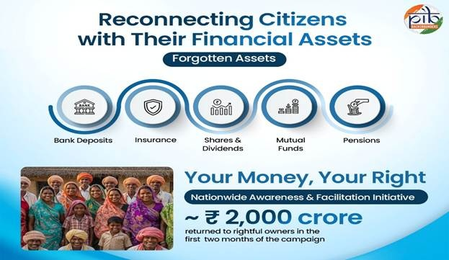
The government has successfully recovered almost Rs 2,000 crore in unclaimed savings from various financial institutions. This amount was stuck in banks, insurance, mutual funds, dividends, shares, and retirement benefits within the regulated financial system. Through the “Your Money, Your Right” initiative launched in October 2025, citizens were assisted in identifying and reclaiming these unclaimed financial assets.
Indian families have diligently saved money across generations through various financial instruments like bank accounts, insurance policies, mutual funds, shares, and retirement plans. These savings are often earmarked for purposes such as education, healthcare, and retirement. However, a significant portion of these savings remained unclaimed over time due to reasons like lack of awareness, outdated records, or changes in personal information.
The unclaimed financial assets in India span different sectors of the formal financial system. Estimates reveal that Indian banks hold around Rs 78,000 crore in unclaimed deposits. Additionally, unclaimed insurance policy proceeds amount to nearly Rs 14,000 crore, while unclaimed mutual fund assets total about Rs 3,000 crore. Unclaimed dividends and shares add up to approximately Rs 9,000 crore.
The “Your Money, Your Right” campaign aims to reconnect citizens with their forgotten financial assets. It seeks to ensure that the unclaimed money, securely held by financial institutions, is rightfully returned to individuals and families.
Unclaimed financial assets arise when account holders or their legal heirs do not claim money held in financial institutions for an extended period. These assets include unoperated bank deposits, unpaid insurance policy proceeds, unredeemed mutual fund amounts, unclaimed dividends and shares, and unclaimed pension and retirement benefits.
The government, in collaboration with various financial regulatory bodies like the RBI, IRDAI, SEBI, IEPFA, and PFRDA, is facilitating the identification and reclaiming of these financial assets by citizens. The process is designed to be simple and transparent, ensuring that individuals receive the money that rightfully belongs to them.
