


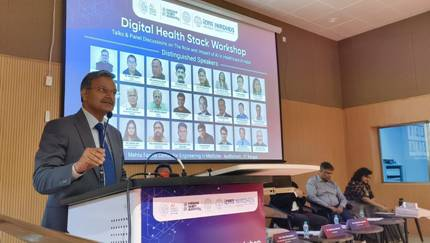
Artificial intelligence models in healthcare, as per National Health Authority CEO Dr. Sunil Kumar Barnwal, should undergo testing on large and diverse population datasets before practical use to ensure trust, accuracy, and inclusivity. Dr. Barnwal emphasized the shift in India towards developing benchmarked and reliable AI models for healthcare during the Federated Intelligence Hackathon on Health AI. He highlighted the importance of federated and consent-driven AI systems in scaling innovation without centralizing sensitive health data, thus safeguarding privacy and enhancing public trust.
Referring to Ayushman Bharat Pradhan Mantri Jan Aarogya Yojana (AB PM-JAY) and the Ayushman Bharat Digital Mission (ABDM), Dr. Barnwal stressed the necessity for AI solutions to be tailored to India’s demographic and regional diversity. The recent national-level hackathon, conducted by the National Health Authority in partnership with ICMR–National Institute for Research in Digital Health and Data Science (NIRDHDS) and IIT Kanpur, focused on developing secure, privacy-preserving, and scalable Digital Public Goods for Health AI. The event, held from January 19 to January 24, 2026, aimed to advance the digital health ecosystem in India.
During the inaugural session, Prof. Sandeep Verma, IIT Kanpur Director Manindra Agrawal, and Ritu Maheshwari, Secretary, Medical Health and Family Welfare and State Mission Director, ABDM–Uttar Pradesh, discussed the significant role of technology, research institutions, and governments in shaping India’s digital health landscape. Dr. R S Sharma, former CEO of the National Health Authority, emphasized the importance of Digital Public Infrastructure and interoperable Digital Public Goods in establishing secure, scalable, and citizen-centric health data systems. Vivek Raghavan, CEO and Co-founder of SarvamAI, highlighted the necessity of high-quality data, robust privacy measures, and security for effective AI integration in healthcare.
