


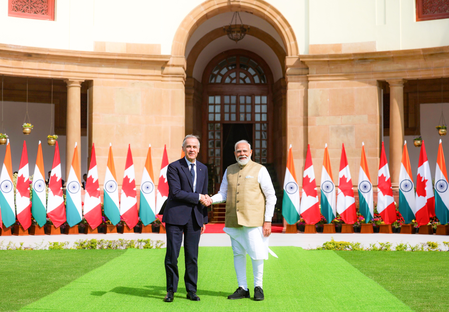
India and Canada strengthened their ties by signing a significant uranium supply deal worth $2.6 billion. The agreement, inked during discussions between Prime Minister Narendra Modi and Canadian Prime Minister Mark Carney, aims to provide India with a stable fuel source for its civil nuclear energy program. Both leaders emphasized that this deal would enhance collaboration in clean and dependable energy sources.
The agreement also paves the way for joint efforts in developing new technologies like small modular reactors and advanced nuclear reactors. In addition to the uranium pact, both countries have agreed to expedite talks on a Comprehensive Economic Partnership Agreement (CEPA). Carney mentioned that they aim to finalize this trade deal by the end of 2026, while PM Modi set a target to boost bilateral trade to $50 billion by 2030, fostering increased investments and job opportunities in both nations.
During the visit, several Memorandums of Understanding were exchanged, covering areas such as cooperation in critical minerals, promotion of renewable energy, and cultural exchange. External Affairs Minister S. Jaishankar and Canadian Foreign Affairs Minister Anita Anand oversaw the signing of these agreements in the presence of the two prime ministers. The collaboration in the critical minerals sector is geared towards establishing robust and dependable supply chains for the future.
PM Modi commended Carney for invigorating India-Canada relations, highlighting the shared democratic values, respect for diversity, and commitment to global welfare. The discussions focused on deepening this partnership based on common values. Both leaders also expanded their cooperation in renewable energy and climate initiatives, with PM Modi welcoming Canada’s participation in the International Solar Alliance and the Global Biofuel Alliance.
Emphasizing the natural partnership between India and Canada in technology and innovation, PM Modi underscored the growing collaboration in areas such as artificial intelligence, quantum technologies, supercomputing, and semiconductors.
