


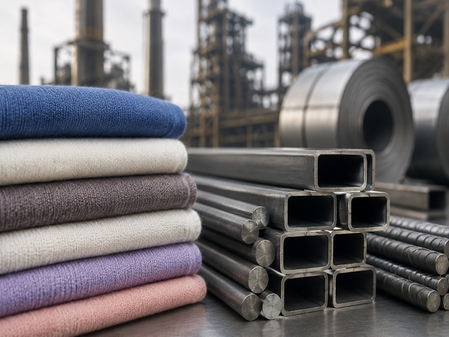
India has rejected assertions by the Trump administration regarding surplus manufacturing capacity in the Indian textile and steel sectors, leading to the export of goods at reduced prices. Amitabh Kumar, Additional Secretary at the Ministry of Commerce, stated that India lacks excess production capacity in these industries, countering allegations being scrutinized under the US Trade Representative’s Section 301 investigation. Kumar emphasized that India’s textile and steel production levels need to be viewed in the context of the country’s large population and increasing consumption demands.
Amitabh Kumar highlighted that on a per capita basis, both production and consumption in India’s textile and steel sectors are significantly lower compared to several developed nations. He mentioned that while new measures are being considered for the steel industry, India does not possess surplus manufacturing capacity. The US Section 301 trade investigation, conducted by the Office of the United States Trade Representative, aims to assess whether foreign government policies or practices unreasonably burden American commerce or violate international trade agreements.
India and the United States are anticipated to finalize their awaited trade agreement post the conclusion of the ongoing Section 301 investigation. Negotiators are working to ensure that no additional tariffs will be imposed upon the completion of the bilateral trade agreement, providing enhanced predictability for businesses and investors. With the temporary 10% tariff regime set to expire on July 24, India seeks more favorable tariff treatment compared to other manufacturing economies, aiming to bolster its status as a global production and export center.
