


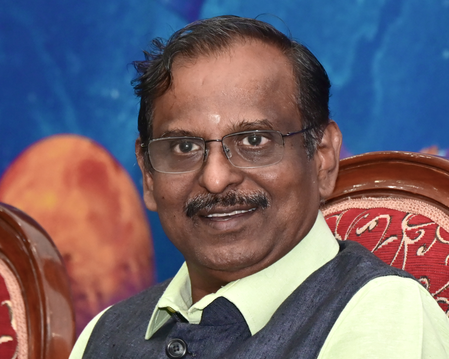
India is making strides in technology to extend the operational lifespan of lunar landers on the Moon to up to 200 days, a significant improvement from the current 14‑day limit achieved by the Chandrayaan‑3 mission, as stated by ISRO Chairman V. Narayanan.
The Indian Space Research Organisation (ISRO), in partnership with the Department of Atomic Energy (DAE), is actively engaged in research in Bengaluru to address the challenge of enduring the harsh and prolonged lunar night. The focus is on developing advanced artificial heating systems to safeguard spacecraft components during the Moon’s extremely low temperatures post-sunset.
The successful landing of a spacecraft near the Moon’s south pole by India on August 23, 2023, through the Chandrayaan‑3 mission marked a historic milestone. However, the Vikram lander’s operational period was limited to one lunar day, equivalent to about 14 Earth days, due to its reliance on solar power generation.
Efforts are underway to enhance the technology with artificial heaters, aiming to enable future lunar landers to function for extended periods of 100 to 200 days, compared to the current 14‑day limitation. This advancement is expected to bolster India’s lunar exploration capabilities, facilitating prolonged scientific experiments, increased data collection, and improved potential for sustained robotic operations on the Moon.
The development of this technology could also be instrumental in supporting upcoming human exploration missions and reinforcing India’s aspirations for a continuous presence on the lunar surface. Narayanan emphasized the need for over 200 satellite launches in the next three years to meet the escalating national and commercial demands, highlighting the necessity for broader involvement from private industry, start‑ups, and academia in the space sector.
