


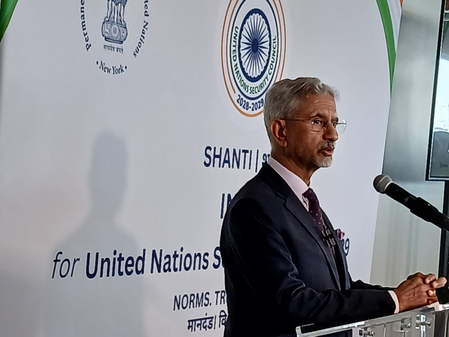
External Affairs Minister S. Jaishankar unveiled India’s bid for the Security Council, emphasizing a six-point manifesto named Shanti, standing for “Securing Holistic Advancement through Norms, Trust [and] Integrity.” India aims to represent the Global South at the Council, highlighting its support for developing nations, peacekeeping efforts, and readiness to tackle modern challenges. Contesting for the Asia-Pacific non-permanent seat in 2028, India continues its anti-terrorism stance, building on its past term’s success.
India is pursuing a dual strategy, vying for a permanent Council seat while seeking an elected position to amplify its voice. Tajikistan is the sole contender for the Asia-Pacific seat currently held by Bahrain. The Organisation for Islamic Cooperation has endorsed Tajikistan’s bid since 2023, emphasizing Islamic solidarity. India must secure a two-thirds majority in the 193-member General Assembly for its election.
During its previous term, India convened a Council meeting in Mumbai, focusing on countering terrorism and its use of modern technologies. Seeking to reduce gaps between its Council terms, India’s bid for the 2028-29 term aims for consistent representation at the UN’s apex decision-making body. With a history of sporadic Council terms since 1950, India strives for a more continuous presence for effective global engagement.
Kyrgyzstan’s recent election to the Asia-Pacific seat precedes Libya’s endorsement for the 2027 Africa seat by the OIC. Noteworthy is Malaysia’s early lobbying for the 2035 Council election, showcasing the strategic planning some nations undertake for future UNSC roles. The Asia-Pacific Group’s support and India’s proactive stance reflect its commitment to global peace and security.
