


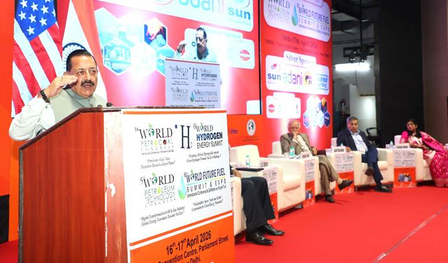
India is emerging as a significant player in the global clean energy arena, as stated by Union Minister of State Dr. Jitendra Singh. The country’s approach involves a strategic blend of policy backing, technological advancements, and industry engagement. Dr. Singh highlighted India’s progress in areas like green hydrogen, nuclear energy expansion, and renewable sources, emphasizing the development of indigenous technologies like electrolysers.
The World Hydrogen Energy Summit witnessed Dr. Singh underlining India’s commitment to fostering a self-reliant ecosystem by boosting research funding and promoting innovation. India’s energy strategy is multifaceted, aiming to ensure both energy security and sustainability. The nation is eyeing substantial investments in oil and gas, an expansion of exploration territories, and a rise in natural gas’s share in the energy matrix to 15%.
Dr. Singh spotlighted India’s National Green Hydrogen Mission, which has allocated Rs 19,744 crore to propel the country towards alternative fuel systems. Green hydrogen is envisioned as pivotal in decarbonizing challenging sectors like steel and cement, with a focus on cost reduction through domestic production and innovative practices. Furthermore, India’s nuclear energy ambitions, including the target of achieving 100 GW of nuclear power capacity by 2047 through the Nuclear Energy Mission, were discussed.
India’s nuclear program has entered a new phase marked by indigenous technological advancements, positioning the country among a select group of nations. The plan to develop five Small Modular/Small Reactors by 2033, with progress already underway on three models, including the Bharat Small Modular Reactor (SMR) and Bharat Small Reactor (BSR), reflects India’s commitment to flexible and decentralized clean energy solutions.
