


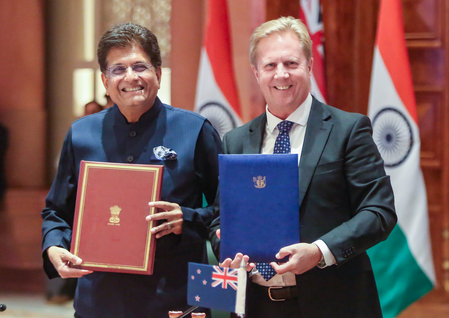
The India-New Zealand Free Trade Agreement, recently finalized, is hailed by global media as a significant advancement in strengthening economic ties between the two democracies and addressing disruptions in global trade caused by US tariff conflicts. The agreement is viewed as a positive step in recalibrating global trade post the trade war declaration by US President Donald Trump.
Trade between India and New Zealand has been steadily increasing, with the FTA aiming to further enhance this growth and solidify their relationship into a more robust and enduring strategic partnership. Notably, total trade between the two nations rose from around $900 million in 2019/20 to $1.3 billion in 2024/25, with India’s exports surging from $379 million to $711 million, and New Zealand’s imports growing from $522 million to $587 million.
Despite the current modest scale of trade, recent trends and the agreement’s structure suggest a promising potential for accelerated and sustained growth. This growth underscores a rising economic interdependence, with both economies identifying mutually beneficial areas for exchange, as highlighted in the article.
The historic FTA signed on April 27 eliminates tariffs on 100% of India’s exports to New Zealand and significantly reduces or removes tariffs on 95% of New Zealand’s imports from India. Additionally, the agreement includes a provision for New Zealand to invest $20 billion in India over 15 years, mirroring the investment commitment made by the European Free Trade Association in their FTA with India.
