


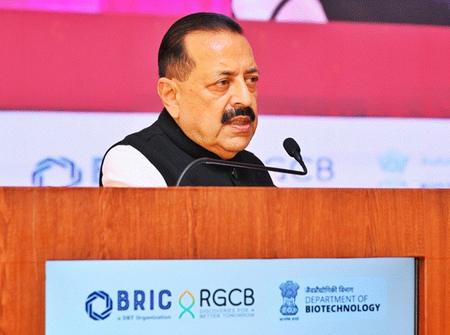
India is gearing up for a bio-driven economy that will revolutionize manufacturing, healthcare, and sustainable growth, as stated by Union Minister Dr. Jitendra Singh. He made these remarks while inaugurating the cutting-edge “Central Facility for Recombinant Cells and Sensors” at BRIC-Rajiv Gandhi Centre for Biotechnology in Thiruvananthapuram, Kerala, on National Science Day.
The newly launched facility is set to enhance India’s capabilities in drug discovery, medical genomics, and agricultural genomics, according to Dr. Jitendra Singh. Holding key portfolios including the Ministry of Science and Technology and Earth Sciences, he also laid the foundation stone for a dedicated GMP facility at the institute and unveiled a book titled “Quantum Physics: One Hundred Magical Years” by Prof. V.P.N. Nampoori.
Addressing a gathering at the Akkulam campus of BRIC-RGCB, Dr. Jitendra Singh highlighted the significant policy support for biotechnology under Prime Minister Narendra Modi’s leadership. He emphasized India’s emergence as a global biotechnology hub and the introduction of the BioE3 Policy, a dedicated biotechnology policy focusing on economy, environment, and employment.
Dr. Jitendra Singh noted the remarkable growth of India’s bioeconomy, which has surged nearly sixteenfold in the past decade from $10 billion to almost $166 billion. The sector is projected to reach $300 billion in the near future, with the number of biotechnology start-ups soaring from 50–70 in 2014 to over 11,000 presently, showcasing a robust innovation ecosystem supported by policy reforms and funding initiatives for deep-tech start-ups.
Speaking about the Central Facility for Recombinant Cells and Sensors, the Minister emphasized its significance as a result of sustained research support. This facility hosts a wide array of engineered recombinant cells and advanced screening systems developed through long-term government-funded programs.
