


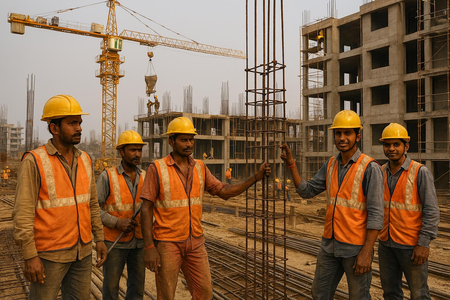
India has been identified as the second-largest individual contributor to global construction growth from 2020 to 2030, as per a recent report. The report, released by Foundamental, a venture capital firm based in Berlin, highlights that India and China collectively make up nearly 40% of the global construction growth during this period. The concentration of global capital expenditure is increasingly seen in five key countries, namely India, China, the United States, Germany, and France.
Global construction spending, which amounted to $15.97 trillion in 2024, is anticipated to escalate to $19.86 trillion by 2028, with a compound annual growth rate (CAGR) of 5.6%. Infrastructure emerges as the fastest-growing major construction sector worldwide, expanding at a CAGR of 5.1% from 2020 to 2025. Notably, in India, the growth rate is significantly higher, with the country’s infrastructure market expected to grow by approximately 8% annually until the end of the decade, surpassing the global average.
The report also underscores the substantial growth in global gross fixed capital formation, which has surged around 30 times since 1960, with a growing concentration of investments in a select few major economies. Shubhankar Bhattacharya, Co-Founder and General Partner at Foundamental, mentioned that the surge in global construction spending has exceeded prior projections, generating fresh prospects across various sectors like infrastructure, industrial facilities, energy systems, transportation networks, and digital infrastructure.
Furthermore, the report predicts a doubling of the global data center construction market by 2030 compared to 2018 levels, primarily propelled by artificial intelligence and cloud computing. This surge positions data center infrastructure as one of the rapidly expanding construction segments through 2030, with the potential to contribute between 10% and 15% to the global construction market by 2030. The report also highlights that India stands to gain from multiple long-term growth trends simultaneously, including infrastructure expansion, industrial progress, energy transformation, digital evolution, and urbanization.
