


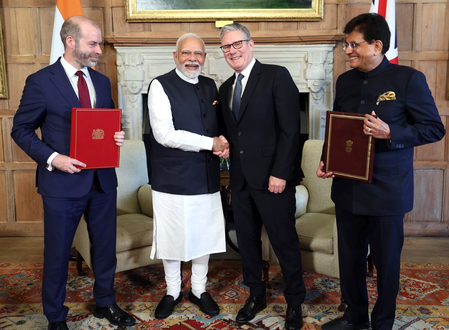
The India-UK Free Trade Agreement, effective from Wednesday, is hailed as a comprehensive deal benefiting farmers, seafood exporters, and labor-intensive industries like textiles. Commerce Secretary Rajesh Agrawal described it as a significant pact with wide sectoral coverage, offering substantial reductions in both tariff and non-tariff barriers. Agrawal emphasized the agreement’s forward-looking economic framework between two major global economies.
Agrawal highlighted the inclusive nature of the agreement, underscoring enhanced access for Indian farmers to the UK agricultural market and duty-free access for seafood exporters. Additionally, labor-intensive sectors such as textiles stand to gain from the elimination of duties up to 12 percent under the FTA. The Commerce Ministry confirmed the completion of all domestic processes for the implementation of the India–UK FTA, with ceremonial consignment flag-off events scheduled for July 15 across various locations in India.
Under the terms, the UK will immediately remove tariffs on 96.8 percent of its tariff lines, accounting for 97.7 percent of the trade value, with an additional 2 percent of tariff lines experiencing reduced tariffs based on quotas. India, on the other hand, will eliminate tariffs on 30.3 percent of trade value immediately, with a phased elimination for 47 percent more, and provide reduced quota-based tariffs on 12.1 percent of trade value, covering a significant portion of tariff lines and trade value.
Agrawal further noted that the FTA addresses non-tariff barriers, ensuring issues like Sanitary and Phytosanitary Measures (SPS) and Technical Barriers to Trade (TBT) do not hinder businesses in the future. He also highlighted the protection of India’s sensitive sectors such as dairy, cereals, pulses, vegetables, gold and jewelry, smartphones, and critical polymers under the agreement. Moreover, the pact includes a reciprocal Double Contributions Convention (DCC) benefiting India’s services sector and skilled workforce.
