


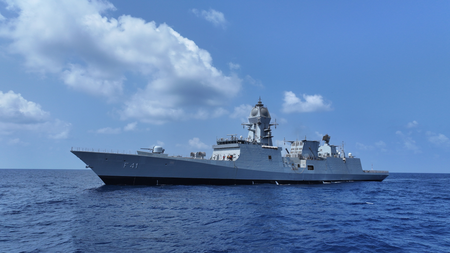
The Indian Navy is gearing up to commission its newest stealth frigate, INS Taragiri (F41), on April 3. This vessel symbolizes India’s progress towards achieving complete self-reliance in naval capabilities. The commissioning ceremony, to be overseen by Defence Minister Rajnath Singh, will underscore the nation’s increasing indigenous prowess in naval technology.
INS Taragiri, part of the Project 17A class of stealth frigates, marks a significant leap in warship design. Powered by a Combined Diesel or Gas (CODOG) propulsion system, Taragiri is tailored for high-speed, high-endurance operations across various maritime domains.
Crafted by Mazagon Dock Shipbuilders Limited (MDL) in Mumbai, this 6,670-tonne warship boasts over 75% indigenous components. The construction of INS Taragiri showcases the success of initiatives like ‘Make in India’ and Aatmanirbharta, with the involvement of over 200 Micro, Small, and Medium Enterprises (MSMEs), generating numerous jobs nationwide.
Beyond its primary role as a formidable naval asset, Taragiri is adept at handling contemporary diplomatic challenges and humanitarian emergencies. Its adaptable mission capabilities range from intense combat scenarios to Humanitarian Assistance and Disaster Relief (HADR) operations.
Armed with a sophisticated array of weapons and sensors, INS Taragiri features supersonic surface-to-surface missiles, medium-range surface-to-air missiles, and a specialized anti-submarine warfare system. These capabilities are seamlessly integrated through an advanced combat management system, enabling swift and synchronized responses in complex operational settings.
The Indian Navy’s evolution into a combat-ready, united, self-reliant force continues, safeguarding the seas for a developed, prosperous India, protected by vessels conceived, constructed, and operated by Indians. INS Taragiri stands as a symbol of India’s ascending maritime strength and a steadfast guardian of its maritime boundaries.
