


Indian Railways has successfully introduced the Kavach Automatic Train Protection system on the Prayagraj–Kanpur section of the Delhi–Howrah corridor. This marks a significant advancement towards enhancing safety and efficiency in train operations. The Kavach system is now operational on the 190-kilometer stretch between Prayagraj and Kanpur.
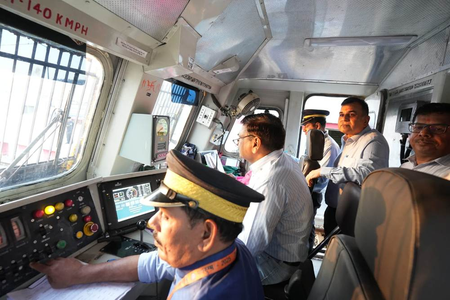
The implementation of the Kavach system involved the activation on Train No. 14163, with the General Manager conducting a performance review through a footplate inspection from Subedarganj to Manauri station. The commissioning, attended by senior railway officials, signifies a crucial milestone in enhancing safety measures and enabling faster train speeds of up to 160 kmph on one of India’s busiest rail routes.
Initially, the Kavach system will be operational on eight pairs of trains, including services like the Chauri Chaura Express and various long-distance trains. Additional trains, including Vande Bharat services, will be gradually included in the system in the upcoming months.
Before the official commissioning, Indian Railways conducted extensive trials to ensure the reliability of the Kavach system. These trials involved test runs with different locomotives and coach configurations, including a 20-coach Vande Bharat train. Passenger trials covering over 20,000 kilometers were also successfully completed without any issues.
Kavach, an indigenous safety system, is designed to prevent accidents resulting from human error. It automatically applies brakes if a train passes a signal at danger, ensuring safe operations by continuously monitoring speed and signals. The system aligns with the government’s initiative to modernize the rail network under the Make in India campaign.
Indian Railways has already deployed Kavach Version 4.0 on over 1,450 route kilometers, including critical sections of the Delhi–Mumbai and Delhi–Howrah corridors. The railway authority plans to expand the system to more routes, with the next phase introducing Kavach on the Ghaziabad–Tundla section as part of Mission Raftaar to enhance train speeds and network efficiency.
