


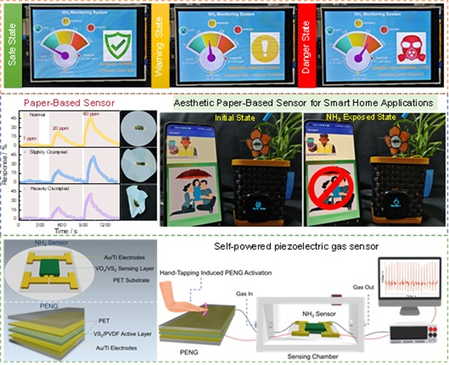
Indian scientists have created a cutting-edge ammonia sensing platform capable of detecting low levels of harmful ammonia at room temperature. The device, developed at the Centre for Nano and Soft Matter Sciences (CeNS) in Bengaluru, offers a solution to the health risks associated with ammonia exposure. It utilizes a highly sensitive gas sensor based on a hybrid vanadium oxide-vanadium sulfide (VOx/VS2) heterostructure.
This innovative sensor, engineered through a specialized surface transformation process, enhances ammonia adsorption and charge transport within the sensing layer. This unique design significantly boosts sensing accuracy, allowing for quick and precise detection of ammonia in ambient conditions. The sensor has been successfully integrated into flexible and wearable versions, suitable for various applications in wearable electronics.
The portable sensor, with detection capabilities down to 319 parts per billion, surpasses safety limits and exhibits excellent selectivity against other gases. It operates efficiently at room temperature, unlike traditional sensors that require higher temperatures. Additionally, a threshold-triggered monitoring system has been developed to provide immediate alerts in case of high ammonia concentrations, categorizing environmental conditions into safe, warning, and danger zones for quick response.
Prototype smart bands, smart-home warning systems, and electronic textile platforms have been created to demonstrate the sensor’s potential applications in personal safety monitoring and environmental sensing. The device’s reliability, energy efficiency, and ease of deployment make it suitable for use in various settings, including industrial facilities, laboratories, and agricultural environments where ammonia leakage poses risks.
