


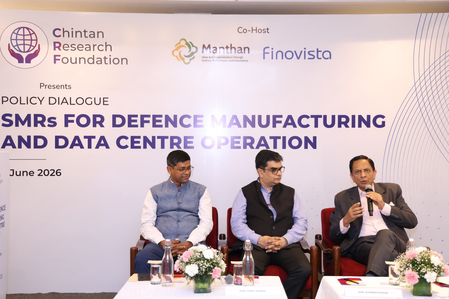
India’s pursuit of defence production and data center goals faces a common challenge: the need for dependable power supply. Experts suggest that small modular reactors (SMRs) could offer precise power support for defence manufacturing, potentially transforming mission-critical operations in emerging defence corridors. At a recent policy dialogue on ‘Small Modular Reactors for Defence Manufacturing and Data Centre Operation,’ Professor R. Srikanth emphasized the essential role of nuclear energy in achieving an energy transition.
The dialogue, a collaborative effort by Chintan Research Foundation (CRF), Finovista, and Manthan, explored various themes related to nuclear energy in India’s low-carbon transition. Participants highlighted the synergy between nuclear and renewable energy in meeting escalating power demands and addressing intermittency challenges. Discussions also delved into the significance of nuclear energy in India’s future energy mix, especially within the framework of Viksit Bharat 2047 and the anticipated shift towards non-fossil fuel-based power generation.
During the dialogue, Shishir Priyadarshi, President of CRF, underscored India’s increasing energy needs, stressing the pivotal role nuclear energy will play in fulfilling industrial and strategic requirements. He pointed out the importance of addressing factors like cost, fuel security, regulation, waste management, and safety to facilitate the widespread adoption of SMRs. Vimal Kumar, Co-Founder of Finovista, highlighted the potential of SMRs in providing reliable and precise power for defence manufacturing.
Prasenjit Pal, former CEO of NTPC Parmanu Urja Nigam Ltd, advocated for viewing India’s 100 GW nuclear vision as a strategic necessity rather than a mere goal. He emphasized the lower carbon footprint of nuclear energy and its critical role in ensuring long-term energy security. The panel discussion, led by Dr. Debajit Palit, brought together experts from various sectors to discuss the role of SMRs in supporting India’s transition to a low-carbon economy, enhancing energy resilience, and meeting infrastructure needs.
Rajnish Kumar, Chief Operating Officer of the National e-Governance Division (NeGD), highlighted the emerging requirements of reliability, resilience, and sovereignty in e-governance systems. He pointed out the potential of SMRs to provide stable power supply for critical infrastructure, emphasizing the necessity of diverse and reliable power sources for secure digital governance.
