
Close Menu
  • Indian Festivals 2026
  • Movie & OTT Releases This Week
  • News
  • Entertainment
  • NRI Life
  • Research
  • Advertise with us
Facebook X (Twitter) Instagram YouTube
  • Download Indian Community App
  • Advertise Here
Facebook X (Twitter) Instagram
Indian CommunityIndian Community
Trending
  • 29 Movie Review: A Heartfelt Romantic Drama That Blooms in Its Own Time
  • Razor Movie Review (2026): Ravi Babu Delivers a Gripping Survival Thriller
  • Sathi Leelavathi Review (2026): Lavanya Tripathi Shines in This Heartfelt Family Entertainer
  • Dug Dug Review (2026): A Sharp and Witty Satire on Blind Faith That Deserves Your Full Attention
  • Main Actor Nahin Hoon Movie Review: Nawazuddin Siddiqui and Chitrangada Satarupa Deliver Career-Best Performances in This Quiet, Powerful Drama
  • Lukkhe Review (2026): King’s Electrifying Debut Turns Punjab’s Rap-Crime World Into Unmissable Drama
  • Daadi Ki Shaadi Review: Neetu Kapoor & Kapil Sharma Deliver a Heartwarming Family Entertainer
  • Godari Gattupaina Review: A Heartfelt Village Love Story That Shines in Its Performances
  • Indian Festivals 2026
  • News
    • National
    • International
    • Entertainment
    • Achievements
    • Scam Alerts
    • Business
    • Health & Medicine
    • Science & Technology
    • Sports
  • Entertainment
  • Latest Movie Releases
    • Latest OTT Releases
  • NRI Life
  • India & Culture
  • Health & Wellness
  • Research
Indian CommunityIndian Community
Home » News » National
National

India’s New Approach to Counter Pakistan’s Nuclear Blackmail

Indian Community Editorial TeamBy Indian Community Editorial TeamMay 7, 20262 Mins ReadNo Comments Add us to Google Preferred Sources
India’s New Approach to Counter Pakistan’s Nuclear Blackmail
Share
Facebook Twitter LinkedIn Pinterest Email

For almost thirty years, Pakistan has pursued a foreign policy centered on sponsoring terrorism against India and leveraging nuclear threats. This strategy has led to a cycle where Pakistan supports terrorism, India responds, and international mediation follows. Western strategic analysts have labeled this approach as nuclear blackmail or escalation diplomacy, emphasizing Pakistan’s use of nuclear threats to support terror activities.
Pakistan’s adoption of tactical nuclear weapons post the 2002 Operation Parakram aimed to deter Indian responses to major terrorist attacks. This strategy was designed to prompt international intervention and freeze conflicts before India could achieve significant objectives.
Despite India’s limited military responses to attacks like the 2016 Uri and 2019 Pulwama incidents, international pressure for de-escalation has consistently favored Pakistan. The false equivalence problem arises when the international community treats both countries as equals during crises, overlooking the state-sponsored terrorism that initiated these conflicts.

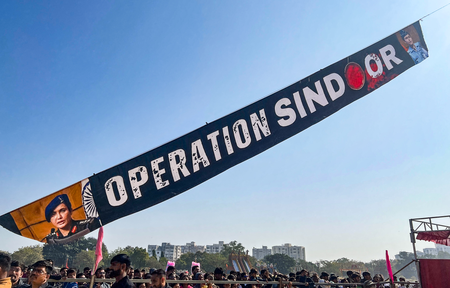
India’s recent military operation, Operation Sindoor, marked a significant shift in its response to cross-border terrorism. Prime Minister Narendra Modi outlined a new approach, emphasizing that India would no longer tolerate nuclear blackmail and would respond to terrorist attacks independently and decisively. This operation, targeting multiple sites in Pakistan and Pakistan-occupied Kashmir, including airbases, showcased India’s resolve to counter nuclear threats without crossing into a nuclear warfare threshold.
By challenging Pakistan’s nuclear blackmail, India demonstrated that a democratic state with conventional superiority can confront terrorism effectively without risking nuclear conflict. This operation’s success carries broader implications beyond South Asia, signaling to other states that the playbook of sponsoring terrorism under nuclear threats may no longer be a viable strategy.

The end of nuclear blackmail between India and Pakistan is crucial globally, as it sets a precedent against using nuclear threats to shield terrorist activities. Operation Sindoor’s success highlights the importance of decisive responses to terrorism without succumbing to nuclear intimidation. By calling out Pakistan’s nuclear blackmail, India has paved the way for other democratic states to resist similar tactics. The international community must acknowledge and address the unique challenges posed by states that exploit nuclear threats to support terrorism, ensuring that such tactics are not replicated elsewhere.

Democratic States Global Security India International Mediation Non-Proliferation Treaty Nuclear Blackmail Nuclear Threats Operation Sindoor Pakistan South Asia Tactical Nuclear Weapons Terrorism
Add us to Google Preferred Sources
Indian Community Editorial Team

The Indian Community Editorial Team curates, verifies, and publishes stories that matter to Indians worldwide. From culture and community to business and innovation, our mission is to spotlight voices, ideas, and events that bring our global community closer together. Have news or a story to share? Submit it to us at [email protected].

Related Posts

India-EU and India-UK Free Trade Agreements: What They Really Mean for Indian Immigration

Canada PR for Indians 2026: 4 Critical Steps to Secure Permanent Residency Through Express Entry

H-1B Visa Interview Appointments for Indians Pushed to 2027: What You Need to Know Now

Add A Comment

Pukhraj Singh Gill Maintains Lead at Players Championship Despite Mid-Round Struggles

May 8, 2026

Bayern Munich’s Alphonso Davies Sidelined with Hamstring Injury

May 8, 2026

Biocon Limited Reports 56.8% Decline in Net Profit for Q4 2026

May 8, 2026

Chad Declares 20-Day State of Emergency in Lake Province After Boko Haram Attacks

May 8, 2026
  • Facebook
  • Twitter
  • Pinterest
  • Instagram
About Us
  • About Us
  • Contact Us
  • Terms of Service
Corporate
  • Download Indian Community App
  • Advertise Here
Facebook X (Twitter) Instagram
  • About Us
  • Contact Us
  • Terms of Service
© 2026 Designed by CreativeMerchants.

Type above and press Enter to search. Press Esc to cancel.