


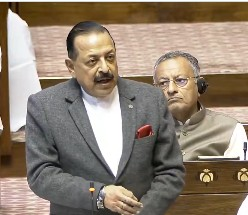
India’s Department of Space/Indian Space Research Organisation (ISRO) is working to reduce the risk of satellite collisions in low-earth orbit by avoiding congested areas and conducting evasive maneuvers, as informed to the Rajya Sabha. Minister of State for Science and Technology, Jitendra Singh, highlighted ISRO’s efforts in strengthening Space Situational Awareness (SSA), including assessing collision risks and performing Collision Avoidance Manoeuvres (CAMs) when necessary.
Responding to queries, the Minister disclosed that the expenditure on the Gaganyaan program has reached around Rs 6,018 crore as of January 2026. ISRO has set up indigenous facilities under the Network for Space Object Tracking and Analysis (NETRA) project to monitor space objects, aiming to achieve zero debris in space by 2030 through the Debris Free Space Mission (DFSM).
ISRO has also ensured additional fuel margins for spacecraft and launch vehicles for post-mission disposal and is exploring rendezvous and proximity operations with robotic arms for active debris removal. India actively participates in international cooperation frameworks like the Inter-Agency Debris Coordination Committee (IADC) and the United Nations Working Group on Long Term Sustainability (UN-LTS), contributing technically to these forums.
The space agency has made progress in measures such as end-of-life deorbiting and passivation of satellites to reduce orbital life, ensuring the disposal of satellites like IRNSS-1D to avoid interference with operational satellites.
