


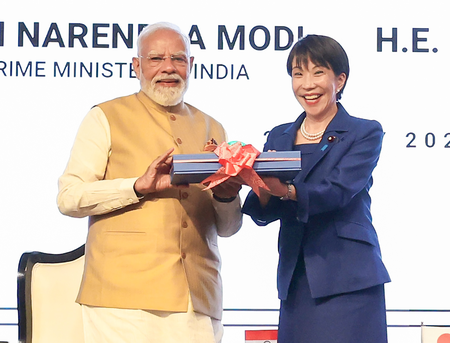
Japan and India have chosen to enhance their interdependence by investing in each other’s industries, defense capabilities, and energy futures rather than pursuing self-sufficiency or relying on external security guarantees. During the 16th Annual Summit in New Delhi, the two nations announced collaborations such as a co-developed defense system for naval communications, a joint roadmap on semiconductors and critical minerals, an artificial intelligence partnership, and a biogas initiative.
Japanese Prime Minister Sanae Takaichi expressed Japan’s commitment to supporting a high-speed rail project connecting Mumbai and Ahmedabad, emphasizing the long-term partnership between the two countries. The joint efforts aim to strengthen economic and military ties without confrontation, focusing on stability and prosperity in the region amidst great-power friction.
The recent India-Japan Annual Summit signifies a shift towards integration over isolation, with both countries prioritizing cooperation in various sectors including defense, technology, energy, health, and infrastructure. This partnership emphasizes mutual trust and cooperation as key strategic assets in building stability in the Indo-Pacific region, highlighting the importance of patient and wide-ranging collaboration between like-minded states.
During her three-day visit to India, Prime Minister Takaichi engaged in discussions with Prime Minister Narendra Modi covering a wide range of bilateral issues, including trade, investment, economic security, energy, emerging technologies, defense, and people-to-people exchanges. The leaders also exchanged views on regional and global developments of shared interest.
