


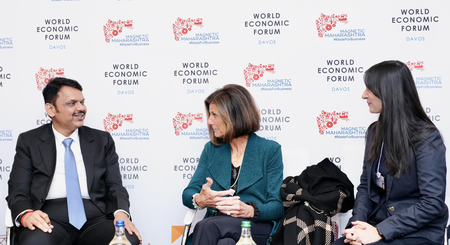
Maharashtra’s Chief Minister Devendra Fadnavis revealed at the World Economic Forum that the state is successfully running Asia’s biggest decentralised solar power initiative. By the year-end, Maharashtra aims to achieve 16 gigawatts of solar power generation. The state’s efforts were highlighted during a session at the World Economic Forum’s annual meeting.
Chief Minister Fadnavis explained how Maharashtra has transformed its energy sector within a short span, particularly benefiting the agricultural domain. The state has effectively shifted its agricultural load to solar power, significantly reducing the cost of supplying electricity to farmers. This move has not only supported farmers but also lessened the financial burden on industries and households.
Maharashtra is also actively participating in the PM Surya Ghar Yojana, with plans to commission around 4 gigawatts of rooftop solar capacity. The state’s initiatives, such as the “Solar Pump on Demand” scheme, have gained substantial traction. Maharashtra leads in solar pump installations across India, with installations expected to surpass 1 million soon.
The transition to solar energy in Maharashtra is proving to be economically and environmentally beneficial. The state anticipates significant financial savings in power purchase costs over the next five years. Moreover, the reduction in carbon emissions due to this program is equivalent to planting 3 billion trees. Maharashtra aims to further boost its renewable energy capacity, targeting 45 gigawatts by 2032, with a majority sourced from solar energy.
To ensure grid stability, Chief Minister Fadnavis highlighted the importance of Battery Storage and Pumped Storage Projects (PSP). Leveraging the region’s geography, Maharashtra has initiated PSPs with a capacity of 80,000 MW, with plans for expansion to 100,000 MW in the near future.
