


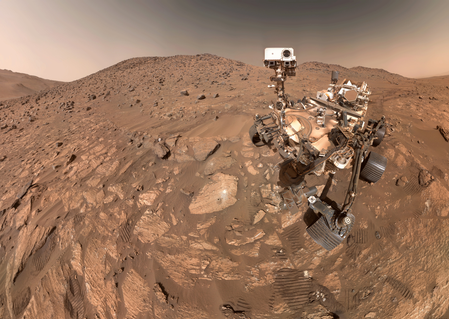
The six-wheeled Perseverance rover, guided by artificial intelligence (AI), has successfully executed its initial drives on Mars. These drives, carried out on December 8 and 10, 2025, were orchestrated using generative AI to chart waypoints for the rover. Typically, this intricate decision-making process is manually handled by human rover planners at NASA’s Jet Propulsion Laboratory in Southern California.
“This demonstration showcases the significant advancements in our capabilities and expands our approach to exploring other planets,” remarked NASA Administrator Jared Isaacman. He emphasized the potential of autonomous technologies like this in enhancing mission efficiency, tackling challenging terrains, and maximizing scientific output as missions venture farther from Earth. Isaacman highlighted the responsible integration of new technologies into real operations as a pivotal aspect of progress.
The Perseverance rover, comparable in size to a car and equipped with seven scientific instruments, has been actively studying Mars since 2021, delving into its geology, atmosphere, and sample collection. During the recent demonstration, the team utilized a form of generative AI known as vision-language models to analyze existing data from the mission’s surface dataset. By leveraging the same imagery and data relied upon by human planners, the AI generated waypoints – specific locations where the rover receives new directives – enabling Perseverance to navigate Mars’ demanding terrain safely.
The initiative, spearheaded by JPL’s Rover Operations Center (ROC) in partnership with Anthropic, employed the company’s Claude AI models. Utilizing a vision-capable AI, the team charted a secure path across Mars’ surface without direct human intervention. Notably, on December 8, with generative AI waypoints integrated, Perseverance covered a distance of 689 feet (210 meters). Subsequently, two days later, it traversed 807 feet (246 meters) with the AI-generated guidance.
