


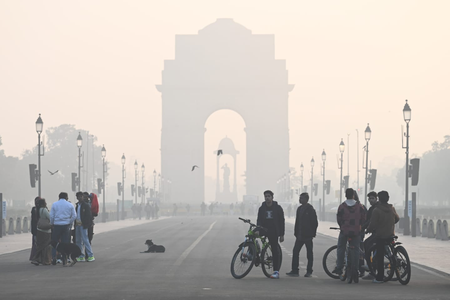
The National Capital Region experienced a slight relief from severe pollution as the Air Quality Index (AQI) dropped to 349, categorizing it as ‘very poor.’ Despite this improvement, some areas in Delhi still reported AQI levels near the severe zone. Noida ranked as the second most polluted city in India with an AQI of 355, followed by Greater Noida at 344, Gurugram at 316, and Ghaziabad at 309, all falling under the ‘very poor’ category.
The India Meteorological Department reported that Delhi had a maximum temperature of 23.2 degrees Celsius, above the seasonal average by 2.5 degrees, and a minimum temperature of 8.8 degrees Celsius, 1.3 degrees higher than normal. The forecast for the day included a minimum temperature of around 9 degrees Celsius and a maximum of about 19 degrees Celsius, with the likelihood of moderate fog during the day. Over the next 24 hours, a gradual decrease in minimum temperatures by 2 to 4 degrees Celsius was predicted for northwest and central India, with Delhi also expected to experience a drop in minimum temperature to around 7 degrees Celsius from the following day onwards.
Following a day of severe pollution, Delhi saw a marginal improvement in air quality with an AQI of 412 in the severe category, a decline from the previous day’s AQI of 373 in the ‘very poor’ category. Despite this improvement, some monitoring stations in Delhi reported severe-plus AQI levels above 450, while 26 stations remained in the severe category. The rest of the monitoring stations in the city indicated ‘very poor’ air quality, as per data from the CPCB’s SAMEER application.
