


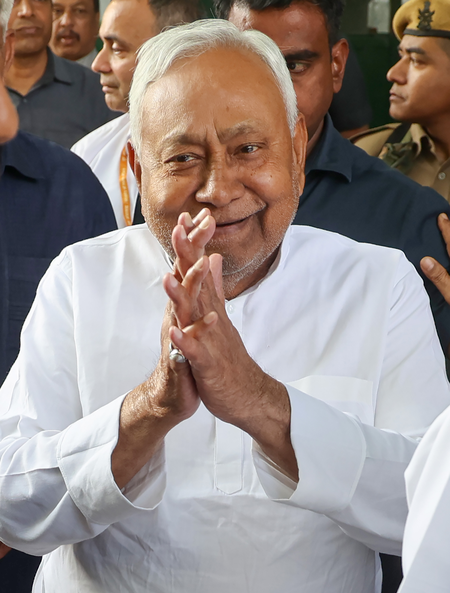
In a significant political move, Nitish Kumar stepped down as the Chief Minister of Bihar on Tuesday, ending his nearly two-decade-long tenure. He has now shifted his focus to national politics after becoming a member of the Rajya Sabha. Nitish Kumar formally submitted his resignation to Governor Syed Ata Hasnain at the Raj Bhavan in Patna, marking the conclusion of the ‘Nitish Era’ in Bihar.
Reflecting on his governance, Nitish Kumar recalled that the NDA government was initially formed under his leadership on November 24, 2005. During his tenure, he prioritized strengthening law and order and promoting inclusive development across all segments of society. Progress was noted in various sectors such as education, healthcare, infrastructure, electricity, and agriculture.
Nitish Kumar highlighted the government’s efforts in empowering women, youth, and marginalized communities like backward classes, extremely backward classes, Dalits, and Mahadalits. He also discussed the ‘7 Nishchay-3’ initiative, outlining the NDA government’s development roadmap for 2025–2030. Nitish Kumar expressed confidence that this plan would propel Bihar’s progress, positioning the state as a significant contributor to India’s growth.
Acknowledging the support of the Central government, Nitish Kumar thanked Prime Minister Narendra Modi for his continued cooperation in Bihar’s development journey. He affirmed that the decision to resign had been finalized before the final Cabinet meeting on Tuesday. Nitish Kumar assured his full cooperation and guidance to the incoming state government, expressing optimism for Bihar’s continued advancement in the future.
Concluding his message, Nitish Kumar extended gratitude to the people of Bihar and his colleagues for their unwavering support during his tenure. His resignation not only signifies the end of an era in Bihar’s politics but also heralds a new phase in the state’s governance, with his influence expected to extend to the national level.
