


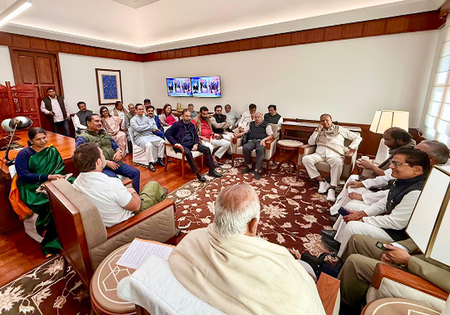
State Assembly elections in 2026 are set to witness Opposition alliances spanning 2,000 km, as parties in Kerala and West Bengal join forces against each other elsewhere. In Kerala, the Left Democratic Front (LDF) led by the Communist Party of India (Marxist) traditionally faces off against the Congress-led United Democratic Front (UDF).
The UDF in Kerala has recently expanded its base by including three more political parties, including the Trinamool Congress. In West Bengal, the CPI(M)-led Left Front is allied with the Congress against the ruling Trinamool Congress, although their official stance for the upcoming polls is yet to be confirmed.
Since the Trinamool Congress gained power in West Bengal, it has chosen to contest elections independently, leading to a three-way competition with the BJP and the Left-Congress alliance. In Kerala, where politics mainly revolve around the LDF and UDF, the BJP has made notable progress recently, potentially impacting voter trust due to perceived inconsistencies in election strategies.
Parties engaging in public accusations signal weak coalition discipline, casting doubt on the opposition’s ability to provide a viable alternative government. In West Bengal, regional identity often supersedes national alliances, with Mamata Banerjee maintaining distance from national partners like the Left and Congress. The ideological rivalry between the Left and Congress in Kerala may also affect the durability of alliances, especially with the Trinamool’s recent entry into the political landscape.
