


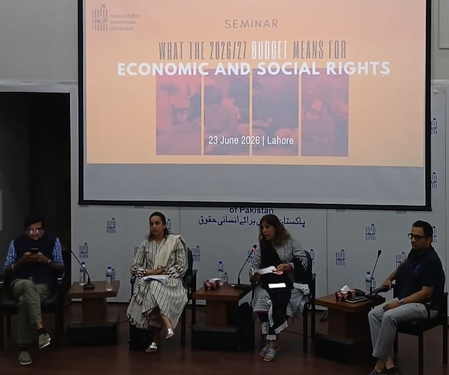
Several Pakistani economists and civil society groups have expressed criticism towards Pakistan’s 2026-27 budget, labeling it as an “austerity” budget that undermines welfare for low-income households, labor rights, and gender equality. At a seminar organized by the Human Rights Commission of Pakistan (HRCP), participants highlighted that the government’s emphasis on “economic stabilization” is coming at the expense of citizens’ well-being and social justice. The seminar included representatives from various civil society organizations and networks, such as South Asia Partnership – Pakistan, Simorgh, the Women’s Action Forum, the Aurat Foundation, and Joint Action Committee, along with labor federations and trade unions nationwide.
According to Pakistani economist Fahd Ali, reduced public expenditure on education, health, social protection, and nutrition is expected to exacerbate existing inequalities in the country. He pointed out that at the household level, shifts in consumption patterns and deteriorating nutritional standards are indicative of increasing economic hardships. Another economist, Hadia Majid, criticized the budget for its gender-related commitments, suggesting that responsibilities for education, health, and protection have been surreptitiously shifted to financially strained provinces.
Furthermore, labor leader and All Pakistan Trade Union Federation (APTUF) secretary general Rubina Jamil raised concerns about the budget’s lack of provisions for the most vulnerable workers. She noted that the budget failed to address the needs of various worker categories, including contract workers, domestic workers, those in hazardous sectors, garment workers, agricultural workers, and pensioners. Jamil emphasized that the budget seemed to favor economic elites over the working class, with inadequate protections for those facing economic insecurities.
Additionally, economist Aqdas Afzal cautioned against the budget’s heavy reliance on indirect taxation and limited tax base expansion, which he believes is disproportionately burdening low-income households and salaried workers. Afzal highlighted the insufficient and unevenly targeted social protection measures, warning of severe implications for households below the poverty line throughout Pakistan.
