


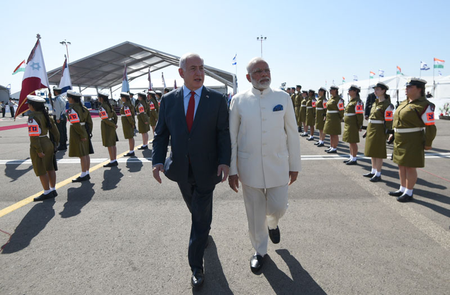
Prime Minister Narendra Modi has arrived in Israel for a two-day state visit, where he is set to have extensive discussions with Israeli Prime Minister Benjamin Netanyahu. This visit includes addressing the Israeli Parliament, Knesset, making him the first Indian Prime Minister to do so. Netanyahu welcomed Modi at the Tel Aviv airport, mirroring their previous meeting in July 2017. Over the next two days, the two leaders are scheduled to interact on various platforms, including a private dinner, a visit to the Holocaust museum, and an address to the Indian diaspora.
The visit is being hailed as historic, reminiscent of Modi’s 2017 visit to Israel, where he was accompanied by Netanyahu throughout the tour. Before this current visit, Modi’s engagement with Israel dates back to his tenure as Gujarat Chief Minister. In May 2006, then CM Narendra Modi led an Indian delegation to Israel’s Agritech 2006, focusing on agricultural technology. The visit aimed to study Israeli advancements in farming and water management, with Modi presenting Gujarat’s agricultural vision at the Israel-India Business Forum.
During his 2017 visit to Israel, Modi and Netanyahu visited a flower farm where a new white chrysanthemum was named “MODI” in honor of the Indian Prime Minister. The trip also saw the signing of a 3-Year Work Programme in Agriculture, formalizing initiatives that Modi had initiated during his earlier visit as Chief Minister. Modi emphasized Israel’s cooperation in agriculture during his address to the Indian diaspora, highlighting the potential for a second green revolution in India with Israeli assistance.
The bilateral relationship between India and Israel has focused on agricultural and water management solutions. India’s need for advanced techniques in these areas aligns with Israel’s expertise in drip irrigation, wastewater recycling, and desalination technologies. Modi’s commitment to these sectors has been evident since his initial visit in 2006, and his return in 2026 underscores the importance of agriculture, water management, and food security in strengthening ties between the two nations.
