


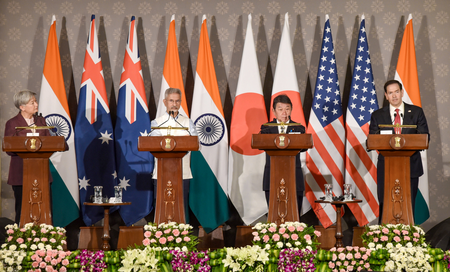
The Quad’s future relevance lies in its ability to adapt as a strategic mechanism rather than mirroring an ‘Asian NATO’ or engaging in rivalry with Beijing. During US Secretary of State Marco Rubio’s recent visit to India, the focus was on the expanding cooperation encompassing maritime security, supply chains, AI, critical minerals, and energy within the Quad framework. The misconception that the Quad’s significance is solely tied to US-China dynamics is considered outdated by former Indian diplomat Raghu Gururaj.
Gururaj emphasizes that the Quad’s effectiveness should be evaluated based on various strategic dimensions, especially in regions like the Gulf and the Indo-Pacific facing geopolitical challenges. The interconnected maritime system linking the Gulf and Indo-Pacific underscores the Quad’s importance in maintaining stability across these critical zones. The grouping’s strength lies in the coordination of strategic capacities among its member nations rather than in formal defense commitments.
The Quad’s strategic success, according to Gururaj, hinges on its ability to ensure freedom of navigation, coordinate naval presence, deter coercion, and uphold stability in the Indo-Pacific region without transforming into a formal alliance structure. The emphasis on maritime domain awareness, undersea cable security, coast guard coordination, logistics interoperability, cyber resilience, and critical sea lanes in the joint statement signifies the Quad’s evolution into a security network rather than a traditional alliance.
Highlighting the Quad’s role in the evolving global security landscape, Gururaj underscores the preference for balancing mechanisms over bloc confrontation, particularly relevant for India. The Quad’s adaptability and credibility in areas like deterrence, trade, technology, and maritime security position it as a flexible and inclusive framework in the current geopolitical scenario.
