


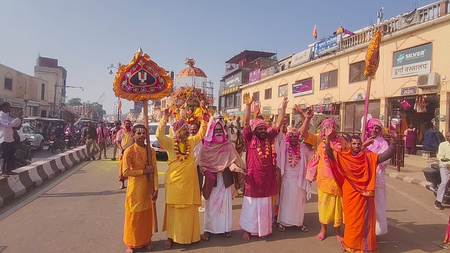
As Rangbhari Ekadashi signals the start of Holi festivities, Ayodhya, Sambhal, and Vrindavan are alive with colorful celebrations blending devotion and joy. In Ayodhya, Holi processions have commenced from temples and monasteries, with Sadhus adorned in ‘abir’ and ‘gulal’ dancing to traditional tunes, marking the festival’s onset. Markets in Ayodhya are bustling with shops adorned in bright hues, offering water guns and masks, including those themed around Prime Minister Narendra Modi and Uttar Pradesh Chief Minister Yogi Adityanath, attracting significant attention.
Sambhal also embraced Rangbhari Ekadashi with fervor as people of all ages were seen immersed in colors, with drum beats and Holi songs resonating through the streets. Women partook in the celebrations by offering prayers at home and temples, applying ‘abir’ and ‘gulal’ to each other. The markets in Sambhal witnessed a surge in crowds purchasing colors and water guns, with strict security measures in place for peaceful festivities, fostering an atmosphere of harmony and brotherhood.
In Vrindavan’s Mathura, devotees congregated at the renowned Banke Bihari temple for Rangbhari Ekadashi, seeking ‘darshan’ and experiencing the divine allure of the celebrations. The festival of colors, Holi, falls on the full moon night of Phalguna, known as Phalguna Purnima. However, a total lunar eclipse on the evening of March 3 has led to adjustments in the religious calendar, prompting some regions to hold Holika Dahan on March 2 and celebrate Holi on March 3, while others will observe Holika Dahan on March 3 and Holi on March 4.
