


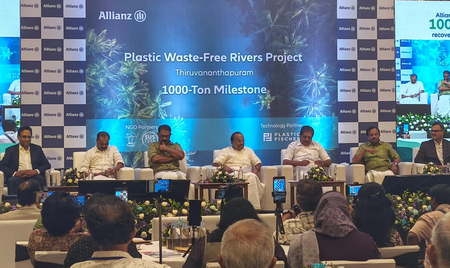
An initiative in Thiruvananthapuram has successfully recovered more than 1,000 tonnes of plastic waste from rivers and canals in the past four years. This effort has prevented the plastic from reaching the Arabian Sea, equivalent to averting nearly 50 million plastic bottles from polluting the city’s waterways. The project showcases how consistent action, supported by technology and proper waste management, can effectively combat environmental challenges in urban areas.
The program not only addresses plastic pollution but also aids in preventing urban flooding during the monsoon season. By enhancing the ecological health of rivers that lead to the sea, this initiative has proven to be beneficial on multiple fronts. Central to this endeavor are 15 floating TrashBoom barriers strategically positioned across key water bodies in the state capital.
These barriers function by capturing floating plastic daily, which is then transported to recovery facilities for sorting. Recyclable plastic is locally repurposed, while non-recyclable materials are sent for co-processing in cement plants, significantly reducing landfill waste. The project, initiated in 2022 and funded through corporate social responsibility (CSR) initiatives, involves the collaboration of tech companies and utilizes technology developed by Plastic Fischer, a Germany-based organization.
Minister P.K. Kunhalikutty, responsible for Industries, IT, AI, and Startups, emphasized that this achievement reflects Kerala’s ability to harmonize industrial growth with environmental conservation. He highlighted the role of Global Capability Centres in not only driving economic progress but also in investing in the communities and ecosystems that sustain them. Water Resources Minister Mons Joseph praised the project as a sustainable model that should be emulated, emphasizing the importance of continuous efforts over one-time clean-up campaigns.
Local Self Government Minister K.M. Shaji encouraged local bodies to enhance cooperation with such initiatives to bolster waste management at the grassroots level. The project’s significance is underscored by studies revealing that a substantial 79% of debris in Thiruvananthapuram’s water bodies comprises plastic, with high microplastic concentrations in the Karamana and Killi rivers. Recognized under the UN Ocean Decade, this pioneering model is now being replicated in various Indian cities, showcasing its potential as a scalable solution to combat plastic pollution in urban water systems.
