


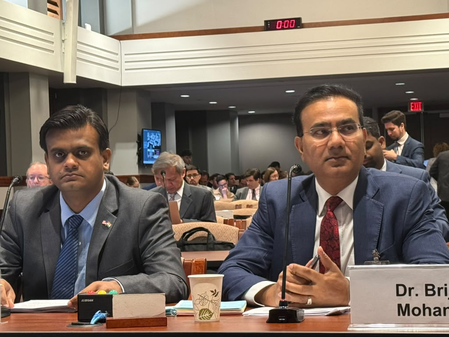
India strongly objected to the proposed 12.5% additional US tariff on its exports during a USTR Section 301 hearing, stating that the investigation lacks legal and factual basis. Dr. Brij Mohan from the Ministry of Commerce and Industry argued that the proposed action would disrupt supply chains without effectively addressing forced labor issues. He highlighted that the USTR failed to justify the recommended tariff rate against Indian imports based on sector-specific evidence.
Dr. Mohan emphasized that the absence of an explicit import ban on goods produced with forced labor does not imply permission for such practices. He stressed the need for tailored policy interventions to combat forced labor instead of broad import restrictions. Additionally, he pointed out the lack of evidence linking India’s regulatory framework to harm in US commerce.
Shreyans Gupta, representing the Agricultural and Processed Food Products Export Development Authority (APEDA), challenged the USTR’s findings on rice imports. Gupta clarified that India’s rice exports to the US mainly consist of geographically indicated basmati rice and non-basmati rice from domestic production. He urged the USTR to reconsider the investigation against India or exempt Indian rice from proposed measures, citing the stringent compliance standards followed by Indian exporters.
Indian industry bodies, including FICCI and CII, supported eliminating forced labor from global supply chains but opposed the economy-wide tariff proposed by the USTR. They advocated for compliance-based cooperation over punitive tariffs, expressing concerns that additional duties would disrupt established US-India supply chains. The USTR initiated the Section 301 investigation to assess trading partners’ enforcement of restrictions on imports produced with forced labor.
