


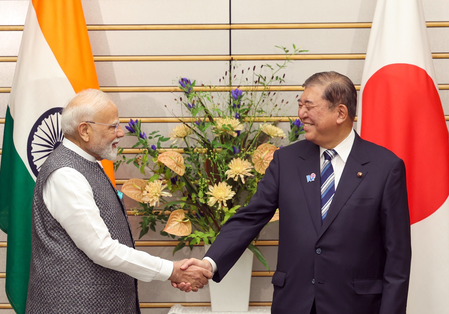
Tokyo: Prime Minister Narendra Modi’s recent visit to Japan was not just another item on the diplomatic calendar — it was a strategic inflection point. Over the last decade, PM Modi has elevated India–Japan relations from ceremonial cordiality into a comprehensive partnership that shapes Asia’s political, technological, and economic landscape. This visit, with its sweeping Joint Vision for the Next Decade, marks the consolidation of that effort and signals how Prime Minister Modi intends to anchor India’s role in Asia’s emerging order.
At the heart of the visit lies the India–Japan Joint Vision for the Next Decade: Eight Directions to Steer the Special Strategic and Global Partnership. Rather than listing disparate projects, the document collapses a multitude of consultation tracks into a single, integrated spine of cooperation. The eight directions — economy, economic security, technology and innovation, green transitions, mobility, health, people-to-people ties, and state–prefecture partnerships — function as platforms rather than projects.
This reflects a signature Modi approach: turning strategy into systems, aligning bureaucracies across ministries, and creating continuity across political cycles.
The economic dimension was decisive. Japan pledged Yen 10 trillion (about $6.8 billion annually) in private and public investment over the next decade. More than a financial headline, this reflects growing confidence in India’s growth trajectory under PM Modi’s stewardship. The investments are tied to high-speed rail, semiconductor manufacturing, clean energy, and advanced technologies — sectors that are central to India’s push for economic modernization, industrial self-reliance, and technological sovereignty. By aligning foreign capital with India’s national priorities, the Prime Minister ensures that external partnerships strengthen internal transformation.
Yet perhaps the most audacious innovation is people as strategy. The Action Plan commits to a two-way exchange of 500,000 personnel in five years, including 50,000 skilled Indians. This is not mere cultural diplomacy — it is a structural rebalancing of manpower resources. By linking language training, certification, and sectoral placements to industry needs in care, manufacturing, construction, and digital services, Prime Minister Modi has turned India’s demographic dividend into bilateral muscle. Importantly, this plan is embedded in state–prefecture partnerships, which means it will be operationalised at the level where infrastructure, permits, and services are delivered — addressing the very bottlenecks that have slowed Japanese capital in India in the past.
Technology and innovation also featured prominently. The visit highlighted collaboration in semiconductors, a critical node in global supply chains where resilience and diversification are urgent. PM Modi’s engagement in Sendai underscored India’s determination to emerge as not merely a consumer but a producer and hub for advanced technologies. The announcement of a joint Chandrayaan-5 mission focused on lunar south-pole exploration demonstrated how India–Japan cooperation now extends to the frontiers of science and space exploration, where symbolism meets strategy.
On the economic stage, PM Modi’s podium craft was on full display at the India–Japan Economic Forum. His assertion that “In India, capital does not just grow, it multiplies” was not a rhetorical flourish but an articulation of India’s investment proposition. He tied that proposition to political stability, policy transparency, and predictability — a subtle reminder that India offers what few other emerging markets can. His framing — “Japan’s excellence and India’s scale can create a perfect partnership” — presented a narrative of complementarity, while his declaration that “India is the springboard for Japanese businesses to the Global South” repositioned India as a gateway, not just a market.
This was a clear call for Japanese firms to anchor long-gestation investments in India’s reforming economy.
The defence and security partnership was another highlight. Both countries reaffirmed their commitment to joint R&D in defence electronics, naval exercises, and interoperability initiatives. These are not symbolic gestures; they enhance India’s indigenous capabilities while embedding its defence sector in broader global value chains. PM Modi has ensured that defence cooperation is not siloed as security policy but is linked to technological and industrial priorities, making it simultaneously a security hedge and a growth driver.
Geopolitically, PM Modi’s leadership was clear and confident. He reaffirmed India’s commitment to a free, open, and rules-based Indo-Pacific, aligning closely with Japan’s own priorities. Maritime security, cybersecurity, and counterterrorism were identified not as abstract agendas but as domains of practical cooperation. Within the Quad, Modi’s stewardship continues to give India–Japan cooperation strategic weight, anchoring a regional order where democratic values guide engagement.
The joint declaration also advanced operational clarity. By aligning Japan’s Free and Open Indo-Pacific (FOIP) with India’s Indo-Pacific Oceans Initiative (IPOI), the two countries built a common vocabulary of regional engagement. The accompanying comprehensive security declaration committed to “evolve our defense and security cooperation to respond to contemporary security challenges,” fusing industry collaboration, supply-chain security, and multi-domain coordination. This was not an abstract principle but an explicit system of deterrence-by-design, where interoperability across sea, air, cyber, and space domains is baked into daily work streams rather than left to episodic communiques.
Taken together, the visit demonstrates Modi’s architectural style of diplomacy: a preference for integrated platforms, measurable targets, and sub-national delivery. From Yen 10 trillion in investment to the exchange of 500,000 personnel, the outcomes are code – like commitments with timelines and metrics. The emphasis on state–prefecture partnerships addresses the long-standing bottlenecks of Japanese investment in India by ensuring that cooperation runs through local systems that handle land, power, water, and clearances.
This visit, therefore, is more than a milestone in India–Japan relations. It is a template for how India engages major partners in the 21st century: by aligning capital with reform, embedding technology in security, translating demographics into strategy, and anchoring geopolitics in operational clarity.
In Tokyo, the partnership’s future was inscribed in numbers, timelines, and mechanisms, not just ceremonial words. And in that design lies Prime Minister Modi’s distinctive hand—turning vision into systems, targets into execution, and partnerships into platforms. The next decade will test whether this code runs at scale and speed. But for now, one truth stands clear: Prime Minister Modi is not merely maintaining a relationship; he is architecting India’s future in Asia.
(Sanjay Kumar Verma is a former Indian diplomat who has served as Indian High Commissioner to Canada, Indian Ambassador to Japan and Sudan. With extensive experience in bilateral, multilateral and regional diplomacy, he is a recognised commentator on India–Japan relations, Indo-Pacific strategy, international trade, and technology policy. Views expressed are personal)
–IANS
/as
