


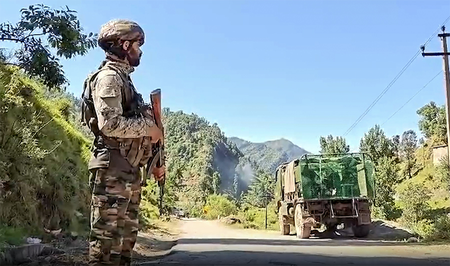
Joint security forces initiated a search operation in the Thanamandi area of Jammu and Kashmir’s Rajouri district following reports from local villagers who claimed to have sighted two terrorists. The operation was triggered by CCTV footage capturing the movement of the suspected individuals crossing a road late at night. Special Operations Group (SOG) of the local police, along with the Central Reserve Police Force (CRPF) and the Army, collaborated to conduct a thorough search operation in the region.
The search parties expanded their efforts to Bhanghai, Hasplote, Karyote, Kopra top, and nearby forested villages to track down the two suspects based on the CCTV evidence. While the search operation is currently ongoing in the area, there has been no direct engagement with the terrorists so far. This operation is part of a sustained anti-terror mission named “Operation Sheruwali,” which commenced in May 2026, targeting suspected terrorist hideouts and infiltration routes in the Manjakote and Sunderbani sectors.
Rajouri district’s history of terrorism is significantly influenced by its proximity to the Line of Control (LoC). The area witnessed a period of heightened militancy in the late 1990s and early 2000s, marked by targeted attacks aimed at displacing local communities. Terrorist groups, operating from the dense forests and rugged terrain, carried out brutal assaults on Hindu minority communities, such as the 1997 massacre of eight villagers and the 1999 Baliyara village attack that claimed seven lives during a marriage procession.
In a shift observed in recent years, heavily armed foreign terrorists have been exploiting the challenging terrain of Rajouri as a transit route and stronghold. This has led to intensified efforts like Operation Sheruwali to eliminate suspected hideouts in the dense woods of the Manjakote area, reflecting the evolving dynamics of terrorism in the region.
