


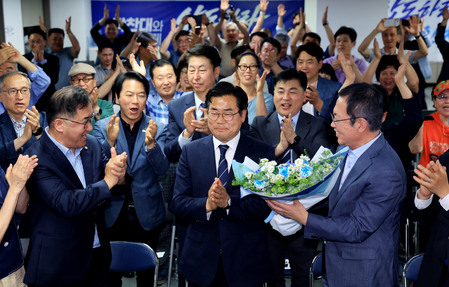
South Korea’s ruling Democratic Party achieved a significant victory in local elections and parliamentary by-elections. The party secured key mayoral seats, notably in Busan, a traditional conservative stronghold, and the main opposition People Power Party retained the Seoul mayoral seat. The Democratic Party won 12 out of 16 key mayoral and gubernatorial seats, with the People Power Party taking the remaining four seats, as confirmed by the final vote count.
The parliamentary by-elections, held alongside the local elections, saw the Democratic Party winning nine out of the 14 seats contested. The People Power Party secured four seats, while an independent candidate won the remaining seat. The ruling party’s loss of four parliamentary seats, out of the 13 previously held, was viewed as a minor setback in the 300-member National Assembly, where the Democratic Party holds the majority.
The elections took place exactly one year after the Lee administration assumed office on June 4. The Democratic Party’s victory is expected to strengthen the government’s mandate for reform initiatives, while posing challenges for the People Power Party in regaining conservative support post the ouster of former President Yoon Suk Yeol. The election results marked a significant shift in voter sentiment compared to the previous local elections, indicating changing political dynamics in the country.
In Gyeonggi Province, veteran Democratic Party lawmaker Choo Mi-ae secured a decisive win against the People Power Party’s candidate, becoming the first female head of a provincial government in South Korea. The capital region, home to half of the country’s population, played a crucial role in the elections. The Democratic Party’s candidate in Busan emerged victorious by a narrow margin against the People Power Party’s contender.
