


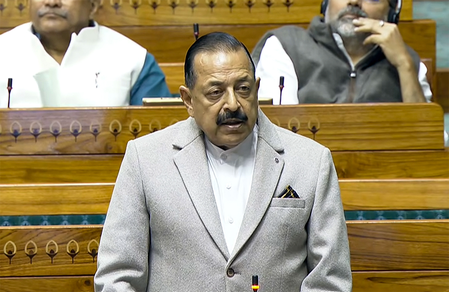
The number of space startups has exceeded 400, with investments in these startups surpassing $500 million, as per information shared in Parliament. Private sector companies successfully tested and launched their vehicles into sub-orbital orbit in November 2022 and May 2024, according to Minister of State Dr. Jitendra Singh. Twenty-five payloads have been or are set to be flown on the PSLV Orbital Experimental Module (POEM) to test and validate the spaceworthiness of payloads by Non-Governmental Entities (NGEs).
The establishment of an Earth Observation (EO) satellite constellation on a Public-Private Partnership (PPP) model is expected to drive innovation and enhance global confidence in Indian space technology companies. State governments are recognizing space as a burgeoning sector and are formulating proactive policies to support companies through incentive schemes. Indian space firms are gradually integrating into global aerospace and space supply chains, with 25 companies currently testing their satellites and subsystems in space using platforms like ‘POEM’.
The ‘Startup India’ initiative, launched in 2016 to foster innovation and create a robust startup ecosystem by providing support, funding, and streamlined regulatory frameworks, has significantly boosted the growth of space-related startups. Notable space startups that have emerged in India post-2014 include Pixxel, Dhruva, Skyroot Aerospace, Agnikul Cosmos, and Bellatrix Aerospace. This initiative aims to transform India into a nation of job creators by nurturing innovation and entrepreneurship.
India’s space startups are playing a pivotal role in enhancing the country’s sovereign space intelligence. For instance, Pixxel, based in Bengaluru, has deployed the initial satellites of its Firefly constellation, the nation’s premier commercial satellite constellation offering cutting-edge hyperspectral imaging. Additionally, the upcoming launch of GalaxEye’s Mission Drishti will equip the nation with a multi-sensor Earth-observation satellite, enhancing India’s “sovereign eyes” for global observation.
