


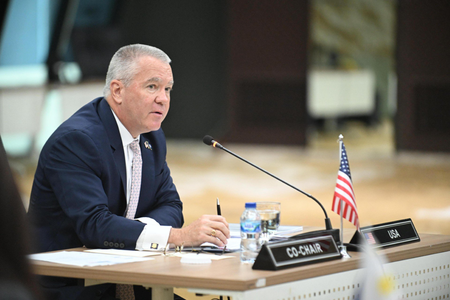
The Trump administration has reiterated its unchanged stance on Taiwan’s policy while considering a $14 billion arms deal for the island amidst escalating Chinese military threats. Michael G. DeSombre, Assistant Secretary of State for East Asian and Pacific Affairs, emphasized the administration’s commitment to the Taiwan Relations Act and existing US-Taiwan relations framework. He highlighted the adherence to the Taiwan Relations Act, joint communiques, and six assurances as guiding principles.
Taiwan was a focal point during the House Foreign Affairs Subcommittee hearing, where lawmakers from both parties raised concerns about military support, deterrence, and China’s increasing pressure on the island. Representative Young Kim commended the administration for approving an $11 billion arms package for Taiwan and mentioned a pending $14 billion arms deal awaiting review. The discussion also addressed President Trump’s remarks on Taiwan arms sales in talks with Chinese President Xi Jinping and their alignment with longstanding US commitments to Taiwan.
DeSombre acknowledged that China consistently raises Taiwan arms sales during bilateral discussions, emphasizing that these talks are routine and not a departure from established commitments. When questioned about the timeline for notifying Congress about the proposed $14 billion package, DeSombre indicated that the decision rests with the President. Republican Representative Andy Barr defended the administration’s support for Taiwan, highlighting the unprecedented $11 billion arms package as a testament to the commitment to Taiwan’s defense.
The approved arms package includes various military systems like HIMARS rocket systems, ATACMS missiles, howitzers, and drones. Barr urged Congress to address delays in delivering over $32 billion worth of previously approved military equipment to Taiwan by bolstering the US defense industrial base. DeSombre echoed the importance of expanding manufacturing capacity and encouraging investments in the American defense industry to expedite foreign military sales. Lawmakers also called on Taiwan to enhance its defense spending and fully fund approved defense capabilities, such as drones, to strengthen its security posture.
Under the Taiwan Relations Act, the US supplies defensive arms to Taiwan while maintaining a policy of “strategic ambiguity” regarding military intervention in the event of a Chinese attack. Despite officially recognizing Beijing over Taipei, the US remains Taiwan’s primary security partner and primary provider of defensive military equipment. Taiwan’s strategic significance in US-China relations and the sensitive nature of the Taiwan issue underscore the complexities in the region.
