


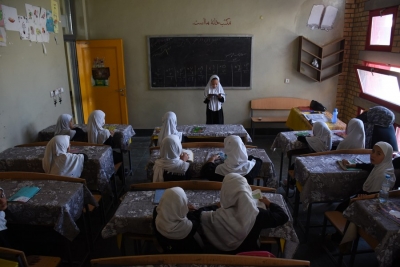
The United Nations has raised concerns about Afghanistan potentially facing a “lost generation” as nearly 3.8 million girls are unable to attend school due to Taliban restrictions. The Acting head of the UN Assistance Mission in Afghanistan, Georgette Gagnon, highlighted that around 3.8 million girls aged 7 to 18 are out of school, with over 2.6 million adolescent girls barred from secondary education.
Gagnon pointed out that an additional 250,000 girls are prevented from accessing secondary education annually. She emphasized that ongoing limitations on women and girls could have lasting effects on Afghanistan’s social and economic progress. Despite some signs of economic stabilization in Afghanistan, including modest growth and enhanced revenue collection, challenges persist.
The UN official also mentioned projections of approximately 2.8 million Afghans returning from neighboring countries by 2026, which will strain resources in a nation already grappling with unemployment, poverty, and inadequate public services. The UN estimates that about 21.9 million people will require humanitarian aid in 2026. Edem Wosornu, Director of Crisis Response at the UN Office for the Coordination of Humanitarian Affairs, highlighted that 4.7 million individuals are at risk of severe food insecurity, while 3.7 million children are confronting acute malnutrition.
The Taliban’s rule in Afghanistan since 2021 has led to severe restrictions on women and girls, such as barring girls from continuing education beyond the sixth grade, restricting women from higher education, and limiting their employment opportunities and access to public spaces. Notably, the recent university entrance exams in Kabul excluded girls for the fourth consecutive year, underscoring the ongoing challenges faced by Afghan women in pursuing education and career opportunities.
