


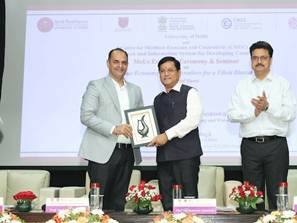
Union Minister of Ports, Shipping, and Waterways Sarbananda Sonowal highlighted India’s maritime sector’s transformative potential for economic growth during an event at the Delhi School of Economics. Two significant Memoranda of Understanding (MoUs) were exchanged, including one between the University of Delhi and the Centre for Maritime Economy and Connectivity (CMEC) at the Research and Information System for Developing Countries (RIS). This MoU aims to enhance maritime education, research, and capacity building in line with India’s long-term maritime vision.
Sonowal, speaking at a seminar on “Blue Economy: Its Imperatives for a Viksit Bharat,” emphasized the crucial role the maritime sector will play in driving India’s economic growth, trade competitiveness, and sustainable development as the nation progresses towards a developed India. He highlighted India’s strategic maritime advantages, such as its extensive coastline of over 11,000 kilometers and 111 national waterways, underscoring the national importance of strengthening the maritime ecosystem.
The collaboration between the University of Delhi and CMEC is seen as a forward-looking step that aims to bridge academia and industry, creating opportunities for youth to engage with India’s expanding maritime sector. The MoU seeks to promote interdisciplinary collaboration between academia and policy institutions, focusing on skill development, capacity building, and research in emerging maritime domains. It includes initiatives like developing academic frameworks for maritime courses, joint research projects, training programs, knowledge dissemination, and professional counseling for students.
The partnership is expected to open new avenues for students and researchers in fields such as maritime logistics, green shipping, supply chain management, and maritime policy, aligning with the broader vision of a sustainable and globally competitive Blue Economy. Sonowal stressed the importance of human capital in India’s maritime ambitions, noting the significant growth in the country’s seafaring workforce over the past years. He highlighted that the collaboration will boost maritime education, research, and skill development, supporting India’s goal to increase its global maritime workforce contribution to 20% by 2030.
