


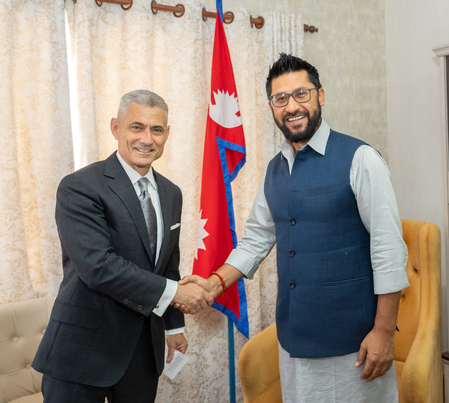
US Assistant Secretary of State for South and Central Asia, Paul Kapur, has initiated discussions with Nepal’s political and business figures during his visit to Kathmandu. This visit marks the first by a senior US official since Nepal’s new government, led by Prime Minister Balendra Shah, took office on March 27 after the March 5 elections.
During his visit, Kapur met with Rabi Lamichhane, President of the Rastriya Swatantra Party (RSP), to understand the party’s priorities within the new government and explore potential areas for collaboration between the US and Nepal. The RSP, Nepal’s largest political party with a significant majority in the House of Representatives, is currently under the leadership of Shah. However, details of the discussions between Lamichhane and the US Assistant Secretary of State remain undisclosed.
In addition to political engagements, Kapur also engaged with leaders from Nepal’s Information and Communication Technology (ICT) sector. Discussions revolved around enhancing US business prospects within Nepal’s ICT industry, focusing on areas such as digital infrastructure, AI integration, cybersecurity, and the exchange of technological knowledge. The US has shown a keen interest in Nepal’s digital infrastructure, particularly concerning the potential adoption of Chinese 5G technology.
The United States has been actively monitoring Nepal’s ICT landscape, particularly in light of Chinese company Huawei’s significant role in supplying 4G equipment to Nepal’s telecom infrastructure. Despite this, Nepal has not yet transitioned to 5G technology. Moreover, the US stands as the primary market for Nepal’s ICT services. Kapur’s agenda also includes engagements with senior government officials, business leaders, and cultural experts to reinforce the US-Nepal partnership.
