


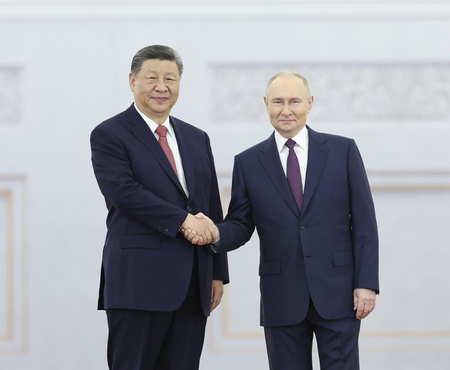
The United States has raised concerns about the increasing militarization of outer space, with China and Russia expanding their capabilities, posing risks to global security and satellite infrastructure. Lawmakers and experts highlighted the evolving strategic landscape during a Congressional hearing, emphasizing the intensifying competition in military, commercial, and diplomatic aspects.
Congressman Keith Self, leading the House subcommittee hearing, stated that space is now considered a congested and contested domain, with the US Space Force categorizing it as a warfighting arena. The focus of the discussion was primarily on China, identified as a significant long-term challenger to US dominance in space. Officials pointed out China’s rapid satellite buildup, launch capabilities, and global partnerships, expressing concerns about its diplomatic and strategic influence using space assets.
The hearing also addressed Russia’s threat in space, particularly its advancements in anti-satellite weaponry. Lawmakers highlighted the potential disruptions these capabilities could cause not only to military systems but also to civilian infrastructure worldwide, including communication, navigation, and financial networks. Experts stressed the critical role of satellites in modern warfare, supporting military operations by providing essential services like connectivity, intelligence, targeting, and weather information.
The discussion underscored the increasing reliance on space-based assets in modern conflicts, citing examples like Ukraine’s use of satellite technology to enhance military capabilities. The growing number of satellites and actors in space was noted as a complicating factor in the strategic environment, with commercial satellites comprising over 80% of the total and more than 100 countries engaged in space activities. Initiatives such as the Artemis Accords, involving over 60 countries, were highlighted as efforts to maintain leadership through partnerships and international cooperation.
Officials emphasized the importance of alliances in shaping the rules of behavior in space, warning of the risks of conflict and miscalculation if stronger norms and coordination are not established. Concerns were raised about the potential for an arms race in space, particularly involving anti-satellite weapons and cyber capabilities targeting critical systems. The strategic competition beyond orbit, especially in developing countries where China is expanding its influence, was also a point of discussion, with calls for a coordinated diplomatic and economic strategy to compete globally.
Experts stressed that the outcome of the competition in space will not only determine technological leadership but also influence the future governance of space activities. The significance of deeper collaboration with partners, including India, was highlighted as crucial for ensuring space security and stability in regions like the Indo-Pacific. The need for distinguishing between benign and aligned actions in space, given the dual-use nature of many space systems, was also emphasized, pointing out the potential risks associated with technologies that could be used for both constructive and destructive purposes.
