


Indian immigrants are driving America’s economy forward — and a new report confirms it. According to recent research, Indian immigrants contribute more to the U.S. economy and federal revenue than any other major immigrant group, saving the government nearly $1.7 million per person over 30 years.
In this Article
Quick Answer:
A groundbreaking study finds that Indian immigrants have the strongest positive fiscal impact in the U.S., reducing national debt and boosting GDP more than any other group, including Chinese and Filipino immigrants.
How Indian Immigrants Positively Shape the U.S. Economy
According to the report by Daniel Di Martino, Indian immigrants contribute significantly to the U.S. economy through multiple channels:
- High Levels of Education: Over 75% hold bachelor’s degrees or higher, often working in STEM, healthcare, and finance.
- Entrepreneurial Spirit: Indian-origin leaders like Sundar Pichai (Google) and Satya Nadella (Microsoft) drive innovation and business creation.
- Low Public Dependence: Minimal reliance on welfare programs allows Indian households to contribute heavily to federal and state taxes.
- Generational Wealth & Stability: Children of Indian immigrants tend to outperform the U.S. average in education and income, continuing the cycle of economic stability.
“Indian immigrants are among the most economically beneficial immigrant groups in U.S. history,” the report concludes.
Fiscal Impact by Country of Origin (30-Year Analysis)
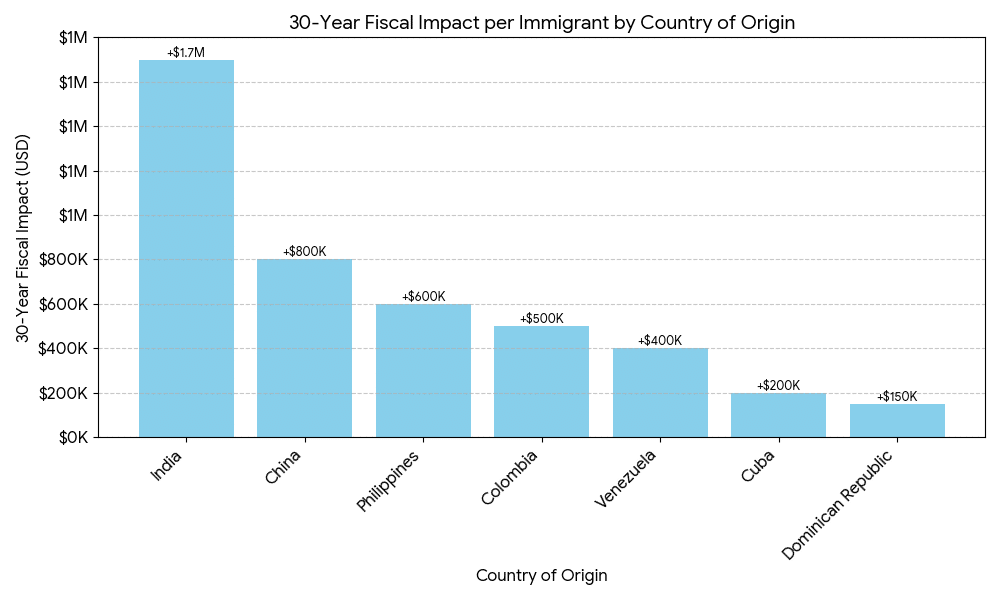
| Country | 30-Year Fiscal Impact per Immigrant |
|---|---|
| India | +$1.7 million |
| China | +$800,000 |
| Philippines | +$600,000 |
| Colombia | +$500,000 |
| Venezuela | +$400,000 |
| Cuba | +$200,000 |
| Dominican Republic | +$150,000 |
The analysis highlights that South Asian immigrants — primarily Indians — and Western Europeans drive the majority of the positive fiscal impact, whereas certain Latin American groups have a more neutral or negative impact.
Why Indian Immigrants Excel Economically in the U.S.
1. High Levels of Education
Over 75% of Indian immigrants hold a bachelor’s degree or higher, compared to just 35% of the overall U.S. population. Many work in high-paying sectors like technology, finance, and healthcare.
2. Entrepreneurial Spirit
Indians in the U.S. have built some of the country’s largest startups.
From Sundar Pichai at Google to Satya Nadella at Microsoft, Indian-origin leaders represent a significant portion of America’s innovation economy.
3. Low Public Dependence
Indian households report lower reliance on social welfare programs, while contributing heavily to both state and federal taxes.
4. Generational Wealth and Stability
The children of Indian immigrants tend to outperform the U.S. average in education and income — continuing the cycle of economic stability.
The Bigger Picture: Immigration and America’s Fiscal Future
While the immigration debate often centers around border control or job competition, this data reframes the discussion — showing that skilled immigration, particularly from India, helps strengthen the U.S. fiscal position.
In contrast, immigrants from countries like El Salvador and Mexico were shown to increase national debt slightly over the same 30-year period due to lower income levels and higher use of public benefits.
The takeaway: A balanced immigration policy emphasizing skill, education, and contribution can directly reduce national debt and boost long-term growth.
Expert Insight
Daniel Di Martino notes:
“The positive fiscal impact of Asian and European immigrants is driven specifically by South Asians — predominantly Indian immigrants — who are boosting GDP while easing fiscal pressure on the U.S. government.”
This aligns with findings from the Pew Research Center and Migration Policy Institute, showing Indian Americans are among the highest-earning and most educated immigrant groups in the country
How do Indian immigrants save the U.S. government $1.7 million?
Through high-income taxes, business creation, and minimal welfare dependence, Indian immigrants contribute more revenue than they cost in services over 30 years.
Which immigrant group ranks second after Indians in fiscal impact?
Chinese immigrants, who reduce the U.S. national debt by about $800,000 per person over 30 years.
Do Indian immigrants contribute to U.S. GDP growth?
Yes. Their participation in technology, science, and entrepreneurship significantly boosts GDP growth.
Indian immigrants have not only integrated successfully but have become an essential pillar of the U.S. economic and fiscal strength.
Their education, work ethic, and entrepreneurial mindset have positioned them as the most economically beneficial immigrant group in the country.
As America debates the future of immigration, the data speaks clearly — investing in skilled immigrants like Indians isn’t just good policy, it’s smart economics.
