


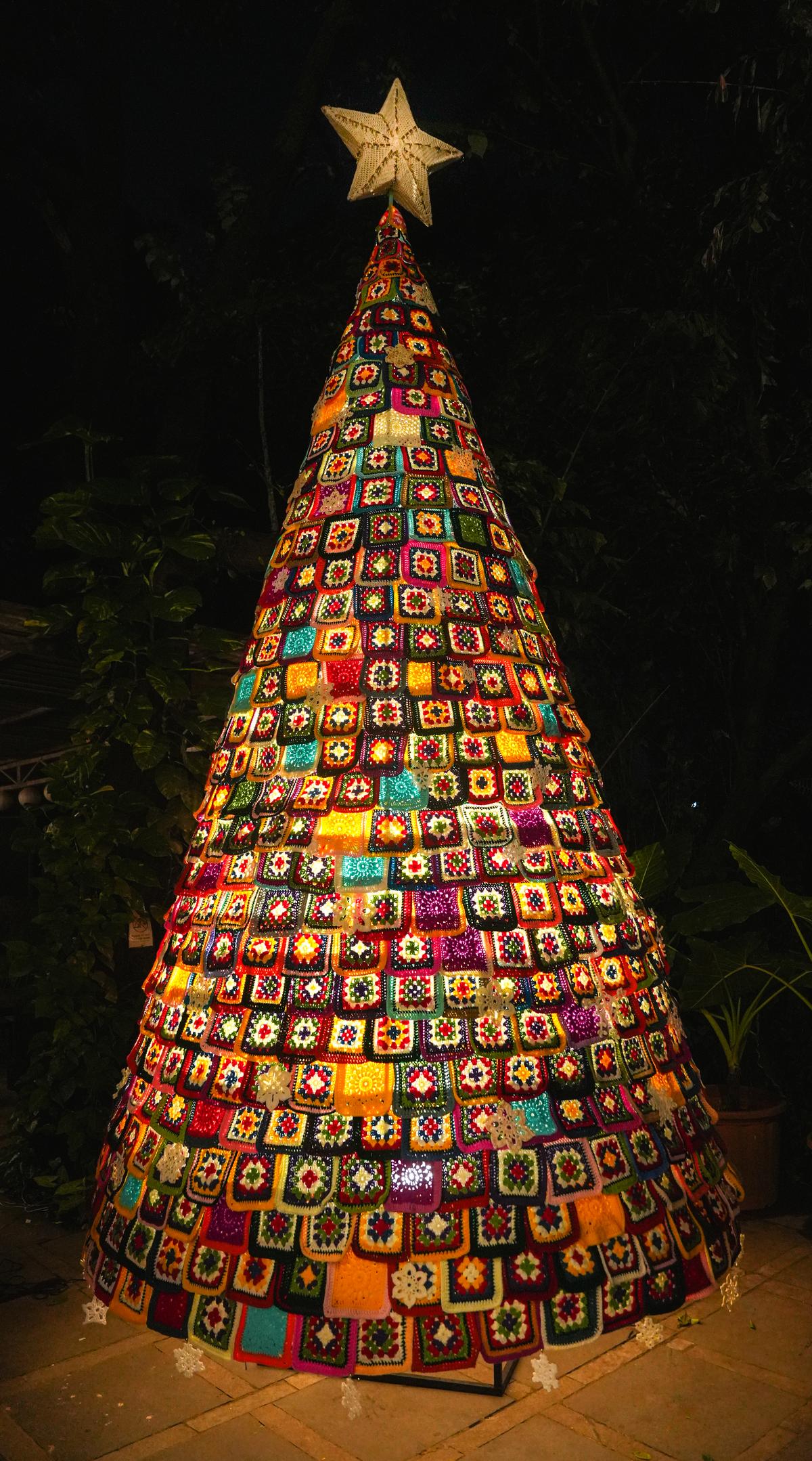
An 18-foot Christmas tree stands at the Museum of Goa this season, but it’s unlike any festive installation you’ve seen before. Made entirely from hand-crocheted yarn, this towering structure comprises over 1,000 individual pieces, each stitched by hand across three months of dedicated work.
Twenty-five women from across Goa came together to create this remarkable installation, supported by civil engineer Laxmikant, who donated the metal frame and logistics. The result is Goa’s first large-scale crochet Christmas tree, created by The Crochet Collective and led by Sheena Pereira, Sharmila Majumdar, and Sophy V Sivaraman.
From Online Community to Public Installation
The project began unexpectedly. Sophy V Sivaraman, new to crochet this year, connected with Sheena Pereira while learning to make a blanket for her grandson’s first birthday. Sheena shared her dream of transforming their COVID-era online crochet group into an offline collective and creating a large crochet tree.
Sharmila Majumdar joined next, despite never having met the founders. “I didn’t know them from Adams, but I came on board,” she recalls. That decision proved pivotal to the project’s success.
Reviving a Traditional Craft
Crochet arrived in Goa through Portuguese influence in the 15th century, taught to women as domestic craft. For generations, it remained a private skill—learned from mothers and grandmothers, practiced at home, and rarely displayed publicly.
“Most of us worked alone. You crochet, and then you put your work into cupboards,” Sharmila explains. The collective changed that dynamic entirely.
Contributors include women who have crocheted for over 50 years alongside those who recently learned the skill. Their first meeting happened via Zoom on August 14, 2025, with many participants meeting for the first time.
Building Without Certainty
The team started without a venue, funding, or even final dimensions. They had yarn, time, and collective determination.
“We decided to begin anyway. We felt the place would come,” says Sharmila. By the time 800 squares were completed, the tree still had no home.
Laxmikant, a civil engineer, donated the entire metal framework, covering structure, transport, and logistics without charge. “He’s just a regular civil engineer, not a fancy guy. But without him, this tree wouldn’t exist,” Sophy notes.
The Museum of Goa eventually provided space, incorporating the tree into “Where We Gather,” a curation of collaborative community projects within the Festivals of Goa.
Sustainable by Necessity
When the team realized their crocheted squares were too small and lacked time to order more yarn, they turned to personal collections. Women brought leftover skeins in unexpected colors—pink, orange, and various shades that created the tree’s vibrant, layered appearance.
“There’s no factory-made decorations. Just what we already had,” Sharmila explains. This constraint became the project’s strongest sustainability statement—a Christmas tree built without plastic, mass-produced décor, or commercial materials.
Community Over Product
Much of the assembly happened at Sharmila’s home, coordinated through WhatsApp messages. Women gathered when they could, stitching hundreds of individual pieces onto the metal frame while sharing food, music, and stories.
Monsoon weather complicated the work. “There was cyclonic weather. We wrapped the tree to protect it from rain,” Sharmila recalls. Between storms, women would unwrap sections, stitch more squares, then cover everything again before the next downpour.
The 25 women who contributed—including Andria Reny Afonso, Alicia D’Souza, Jennifer Fernandes, Carol Braganza, and others—brought more than technical skill. They invested time, care, and presence in ways that transformed private craft into public art.
Beyond the Installation
At a recent crochet pop-up at the Museum of Goa, contributors demonstrated they’re not hobbyists but professionals who understand their work’s value. They ran their tables with business acumen, comfortable discussing pricing while remaining generous with their stories.
The collective is already planning future projects, ensuring crochet continues evolving from private cupboards to public spaces. As Sophy puts it: “You have to like being copied. Do things so well that others want to replicate them.”
The 18-foot tree won’t last forever, but the community it created and the model it established will continue growing—proof that sustainable festive décor, traditional craft revival, and women’s collaborative labour can create something both beautiful and meaningful.
