


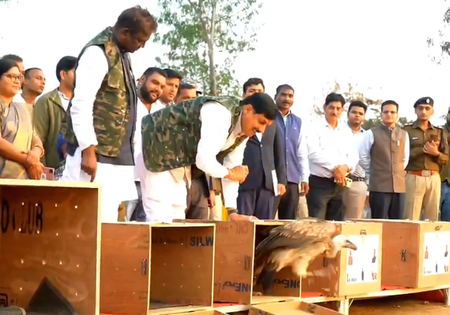
Chief Minister Mohan Yadav released five endangered vultures into the Halali Dam water wetland in Raisen, emphasizing the significance of vultures in Indian tradition as symbols of strength and sacrifice. The birds, including Indian Vultures and a Cinereous Vulture, were equipped with GPS-GSM satellite transmitters before their release.
The tagging process was overseen by wildlife veterinarians from Wildlife SOS and representatives from relevant institutions and the Forest Department. This initiative aims to enhance understanding of the vulture landscape in Central India, with Indian Vultures known to stay within local territories and Cinereous Vultures undertaking long-distance migrations along the Central Asian Flyway.
Madhya Pradesh’s Forest Department has initiated a satellite telemetry program in collaboration with WWF-India and the Bombay Natural History Society to strengthen bird conservation efforts. This program will provide crucial insights into vulture movement patterns, habitat use, and responses to human-induced pressures, aiding in the development of effective threat-mitigation strategies.
The state of Madhya Pradesh has been a stronghold for vulture populations, hosting various species including the Indian Vulture, Cinereous Vulture, Egyptian Vulture, and Himalayan Griffon. Recent vulture estimations in the South Panna Forest Division recorded over 1,000 vultures on the first day, marking a significant observation in recent years.
