


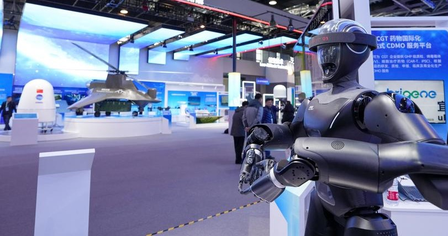
China’s progress in artificial intelligence, robotics, and autonomous systems is viewed as a growing threat to US national security, as highlighted by American lawmakers and industry experts. Concerns encompass issues such as data access, cyber vulnerabilities, supply-chain reliance, and potential military applications. Chairman Andrew Garbarino emphasized this challenge unfolding within the United States during a House Homeland Security subcommittee hearing.
Garbarino pointed out that China is aggressively pursuing dominance in technologies reshaping the global economy and security, including artificial intelligence, robotics, and autonomous systems. Specifically, he mentioned Chinese companies like DeepSeek and Unitree. DeepSeek, in particular, drew attention for releasing a model in January 2025 that rivaled top American systems at a significantly lower cost, leading to concerns of intellectual property theft.
The deeper worry lies in allegations that DeepSeek may have unlawfully incorporated outputs from leading American AI systems into its training process, essentially reverse engineering capabilities developed by American companies. Moreover, the concern extends to the company’s app available on the Apple App Store, where user interactions are stored on servers in China, raising data security issues. Industry and policy experts advocated for a stronger US response to these challenges.
Experts highlighted the importance of addressing China’s dominance in the robotics AI data market, emphasizing the need for the US to focus on data and implementation to secure its future position in the technological landscape. They warned that compromised robots could pose significant risks beyond typical connected devices, potentially leading to sabotage of critical systems. Concerns were also raised about China’s strategic efforts to weaken the US robotics industrial base and infiltrate critical infrastructure.
The rapid pace of China’s technological advancements, particularly in robotics, has outpaced many American industries. This disparity was exemplified by the installation of industrial robots in Chinese factories compared to American counterparts. Experts also cautioned about the espionage risks posed by Chinese laws that could compel firms to cooperate with state intelligence. Calls were made for stricter procurement restrictions on Chinese technologies in sensitive federal environments, similar to measures imposed on companies like Huawei and DJI.
