


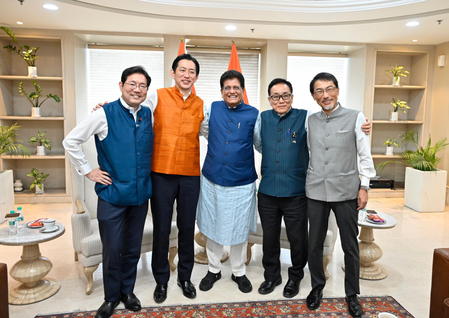
Commerce and Industry Minister Piyush Goyal recently engaged in discussions with a Japanese delegation to enhance trade and investment ties between the two nations. Goyal met with Mr. Takayuki Kobayashi, who leads the ruling Liberal Democratic Party’s Policy Research Council in Japan, to explore avenues for strengthening economic cooperation. The talks centered on boosting India–Japan economic engagement, fostering partnerships in sectors like automobiles, infrastructure, pharmaceuticals, and advanced manufacturing.
Goyal emphasized the importance of increasing exports from India and enhancing market access during the discussions. He reiterated India’s dedication to bolstering the business environment while looking into future opportunities under CEPA and broader Indo-Pacific economic collaboration frameworks. As global supply chains undergo transformations and businesses seek alternatives to China, India has emerged as an attractive long-term investment destination. This presents an opportunity for Japanese mid-sized companies to collaborate with Indian MSMEs to drive growth, given India’s competitive export potential.
The India–Japan Joint Vision for the Next Decade, established during Prime Minister Narendra Modi’s visit to Tokyo in August 2025, promotes cooperation among SMEs by facilitating visits by Japanese SMEs to India and expanding downstream industries. Japan is keen on encouraging its companies to view India as a production hub, considering India’s export-oriented policies and extensive trade agreement network. The two countries have identified several sectors for potential cooperation in the upcoming years, with semiconductors and electronics standing out as promising areas. Japan’s expertise in semiconductor technologies aligns well with India’s expanding electronics market and strong government support.
India’s sizable domestic market provides a stable foundation for sustained business growth and acts as a safeguard against global market fluctuations. Its strategic geographical position enhances its attractiveness for accessing markets in the Middle East and Africa. Japanese companies establishing manufacturing units in India can leverage these global connections to expand their international presence. Additionally, India’s existing and forthcoming free trade agreements and bilateral partnerships with major global economies offer new market opportunities amidst global uncertainties.
