


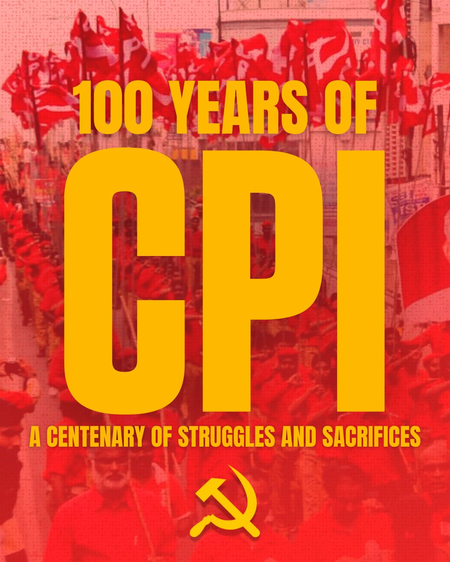
The Communist Party of India (CPI) is celebrating its centenary on December 26, with events taking place in New Delhi. General Secretary D. Raja will lead the festivities by hoisting the party flag at Ajay Bhavan. The occasion includes a seminar titled “100 Years of the CPI — Tradition and the Future,” along with cultural programs and an exhibition showcasing the party’s historical journey.
The CPI has a significant historical legacy, notably highlighted by E.M.S. Namboothiripad leading the world’s first democratically elected communist government in Kerala in 1957. This milestone positioned the CPI at the forefront of parliamentary Left politics, blending ideology with electoral legitimacy.
Following an ideological split in 1964 that led to the formation of the CPI(M), the CPI faced challenges in maintaining its organizational strength and political influence, particularly in Kerala. Despite this, the CPI continued to play a crucial role in Kerala’s political landscape through various alliances and government formations.
In 1980, the CPI made a strategic shift by breaking away from the Congress and aligning firmly with the Left Democratic Front (LDF), becoming its second-largest constituent in Kerala. Currently, the CPI holds key positions within the LDF government in Kerala and remains part of the ruling alliance in Tamil Nadu under the DMK.
Nationally, the CPI’s presence has diminished over the years. With limited representation in the Lok Sabha, Rajya Sabha, and state legislatures, the party is recognized as a state-level entity in Kerala, Tamil Nadu, and Manipur. As the CPI enters its second century, it faces the challenge of maintaining political relevance in a changing Left political landscape.
