


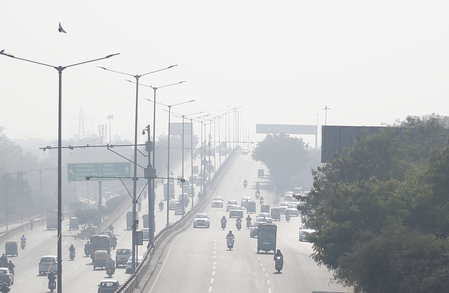
The air quality in Delhi has stayed in the ‘poor’ category for the fifth day in a row. At 8 a.m., Anand Vihar reported an Air Quality Index (AQI) of 299, indicating very poor air quality. On Wednesday, the overall air quality in Delhi was ‘poor,’ with Anand Vihar recording ‘very poor’ conditions at an AQI of 342. Concerns are growing among residents and authorities due to the persistent pollution levels.
As per the Central Pollution Control Board (CPCB), various monitoring stations in Delhi showed AQI readings on Thursday morning. Anand Vihar recorded 299, Ashok Vihar 212, Bawana 269, and other areas also reported air quality in the ‘poor’ to ‘moderate’ categories. To enhance air quality monitoring, six new Continuous Ambient Air Quality Monitoring Stations (CAAQMS) have been activated in Delhi, bringing the total to 46, the highest in the country.
The Public Works Department (PWD) and urban development departments of Delhi, Haryana, Uttar Pradesh, and Rajasthan have signed agreements with expert institutions to implement a standard framework and Road Asset Management System (RAMS) to tackle road dust, a significant contributor to PM10 pollution. Delhi-NCR’s air pollution problem is addressed in the NCERT’s new Class 8 Social Science textbook, discussing environmental challenges in urban India, including high AQI levels.
Summer-like conditions have started appearing in parts of North India, with rising daytime temperatures in states like Delhi, Uttar Pradesh, Bihar, and Rajasthan. Some areas in Rajasthan have seen maximum temperatures exceeding 36 degrees Celsius. The India Meteorological Department (IMD) forecasts a gradual increase in both maximum and minimum temperatures in Delhi-NCR in the upcoming days, accompanied by strong surface winds during the daytime.
