


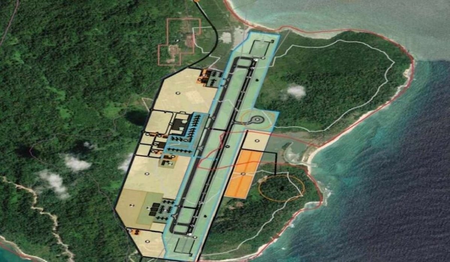
The Great Nicobar Project is underway to transform Great Nicobar into a strategic maritime and economic hub, leveraging its proximity to the global East–West shipping route. This initiative aims to reduce India’s reliance on foreign transshipment ports, emphasizing national security and defense concerns. The project seeks to enhance India’s strategic presence in the Andaman Sea and Southeast Asia while balancing economic growth with environmental protection and indigenous community preservation.
The project includes significant infrastructure components such as an International Container Transshipment Terminal with a capacity of 14.2 million twenty-foot equivalent units (MTEU), a Greenfield International Airport, a 450 MVA gas–solar power plant, and a planned township. India’s lack of deep-water berths for large ships currently forces cargo to be routed through ports in Colombo and Singapore, resulting in revenue loss.
The International Container Transhipment Port (ICTP) at Galathea Bay is part of the Holistic Development of Great Nicobar Island under the Island Development program. Situated about 40 nautical miles from the East-West international shipping route, the port’s natural water depth of over 20 meters makes it strategically important for attracting gateway and transshipment cargo, reducing India’s dependency on foreign ports.
The development of the port adheres to an environmental framework, involving the diversion of 1.82% of the island’s forest cover and compensatory afforestation over 97.3 square kilometers. The island’s ecological resources are expected to draw international and Indian tourists, necessitating an international airport for improved connectivity. The planned township will cater to residential, commercial, and institutional needs arising from the port-led development, supporting urban infrastructure and economic activities.
